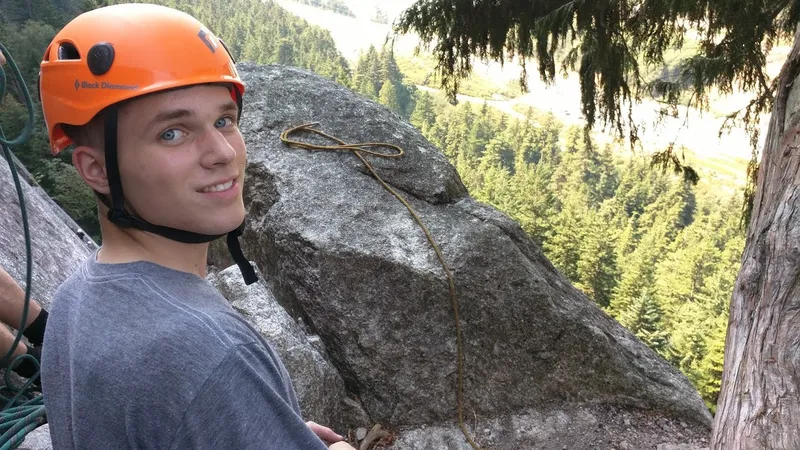
The granite at Smoke Bluffs holds the morning cold. We gather at the base of the route in the blue shadow of the rock face, a group of clinical supervisees and myself, ropes coiled, harnesses laid out on the moss. Most of them have never climbed. The anxiety is palpable—I can see it in the way they stand slightly back from the wall, arms crossed, studying the rock as though it might offer an escape clause.
Andrew stands farthest back. He has already told me, twice, that he will not be climbing today. He is here to observe. His arms are folded tight across his chest, his weight shifted away from the group. I recognize the posture. It is the shape the body takes when the nervous system has decided: not this, not now, not ever.
I do not argue with him. There is no point in arguing with a nervous system. It does not negotiate verbally.
The morning unfolds. Others go up—tentative at first, then finding holds, finding rhythm. Laughter begins to replace the tight silence. Andrew watches. His posture does not change, but his attention does. Something in him is tracking the others, registering that they are not falling, not failing, not being harmed. His nervous system is taking data.
By early afternoon, he asks if he can try.
I help him into the harness. His hands are shaking as he ties in, but he ties in. He places his fingers on the first hold—cool granite, textured with crystals—and begins to climb. Slowly. Each move deliberate, each placement tested before he commits his weight. Halfway up, he pauses. I can see him breathing. He is not frozen; he is regulating. There is a difference. The frozen body does not breathe deeply. The regulating body does.
He reaches the top. From below, I watch him stand on the ledge, one hand still on the anchor, looking out over the forest toward the Chief—that massive granite dome that rises above the Squamish valley. He lets out a sound that is part laugh, part sob. It is the sound of a nervous system discovering that it has capacity it did not know about.
When he comes down, he is a different person. Not transformed in some permanent way—I do not believe in cinematic epiphanies—but shifted. His shoulders are lower. His breathing is slower. He keeps looking at his hands as though they belong to someone else, someone capable of things he had not imagined.
This is what the research cannot quite capture: the moment when the body learns something the mind has refused to believe.
The Evidence We Resist
The research is overwhelming, and we resist it anyway.
Network meta-analyses now show that physical exercise matches or exceeds the effectiveness of antidepressants for depression. Effect sizes for movement-based interventions range from 0.42 to 1.26—comparable to or better than both medication and psychotherapy. Walking, running, climbing, strength training: the evidence accumulates across modalities, across populations, across diagnostic categories. A 2024 meta-analysis published in the British Medical Journal examined over 200 randomized controlled trials and concluded that exercise should be considered a first-line treatment for depression.
And yet.
We continue to reach first for pills. We continue to privilege the therapist’s office over the trail, the gym, the climbing wall. We continue to treat the body as a vehicle for carrying the brain to its next appointment. This is not because the evidence is hidden. The evidence is everywhere. We resist it because accepting it would require us to revise a story we have told ourselves—a story about the nature of suffering and what it takes to heal.
The story we prefer: mental distress is a biochemical problem requiring biochemical solutions, administered by experts in controlled settings. The story the evidence tells: the nervous system learns through doing, changes through experience, reorganizes through encounter with challenge. The body is not merely a symptom-carrier. The body is the site of healing itself.
The Nervous System Learns Through Doing
I have spent decades mapping what I call the geography of healing—the terrain that trauma creates in the body and the paths by which that terrain can be reshaped. Four patterns emerge repeatedly: flight, freeze, orient, and fight. Each represents a different way the nervous system organized itself to survive what was, at some point, unsurvivable by other means.
Flight manifests as the urge toward elsewhere—dissociation, escape, the addictions I call elsewhere addictions because they serve a singular purpose: departure from the unbearable here and now. Freeze shows up as collapse, immobility, depression, the solace addictions that numb rather than escape. Orient appears as hypervigilance, anxiety, the scanning that never stops. Fight emerges as rage, defiance, the refusal to be harmed again that becomes its own harm.
These patterns formed through embodied experience during critical developmental windows. The body learned them. The body remembers them. And here is the essential point that the research now confirms: if the pattern formed through embodied experience, it can only be reorganized through embodied experience.
This is why Andrew’s nervous system could not be argued out of its refusal. Talk alone often struggles to reach the subcortical structures—the brainstem and limbic regions—where trauma responses are organized. Insight can shift how we understand our patterns, but understanding is not the same as reorganization. The nervous system changes most reliably through encounter—through direct experience that contradicts its predictions about danger and capacity.
The Vertical Puzzle
Climbing is a particular kind of encounter. The granite at Smoke Bluffs demands something specific: full presence while maintaining voluntary control.
For someone like Andrew, whose nervous system had organized around freeze, the route presented an impossible puzzle. To freeze on a climb is to fail—the body must keep moving, must keep solving, must keep engaging. But the movement is not escape. You cannot flee upward and away; you must remain present with each hold, each placement, each shift of weight. The rock insists on being met.
Research on bouldering and depression—and there is now substantial research—shows that climbing produces larger reductions in depressive symptoms than general exercise alone. A 2020 randomized controlled trial found that eight weeks of bouldering therapy outperformed both a physical exercise control and a waitlist control for treating depression. The researchers speculated about mechanisms: the combination of problem-solving, physical exertion, and social connection. But I think they missed the deeper pattern.
Climbing addresses the trauma responses directly:
For flight responses, climbing demands presence. You cannot dissociate on a route—the consequence of absence is immediate and physical. Yet you retain control. You can pause. You can breathe. You can choose your next move. This is the opposite of the helplessness in which flight patterns formed.
For freeze responses—Andrew’s pattern—climbing insists on agency. The body must act. But the action is graduated, chosen, reversible. You can come down at any point. The nervous system learns that movement does not lead to catastrophe.
For hypervigilance, climbing provides a legitimate target. The scanning energy that exhausts itself searching for threats in safe rooms can pour into route-reading, hold-assessment, risk evaluation. Vigilance becomes productive rather than parasitic.
For rage, climbing offers challenge that respects rather than diminishes power. The rock does not submit, does not back down, does not become the object of destruction. It simply presents the problem. Strength meets resistance, and something is built rather than broken.
Running From and Toward
Running works differently but arrives at similar territory.
The rhythm of footfall, breath cycling in and out, heart rate rising and settling into sustainable effort—these are not merely physical events. They are regulatory interventions. The nervous system that has lost its ability to modulate arousal finds, in running, a practice ground for recovery. You push into discomfort; you discover you can tolerate it. You regulate breathing; the body learns that activation need not spiral into panic. You finish; you learn that intensity has an end.
A 2023 study compared running therapy directly to antidepressant medication. Both groups improved on measures of depression and anxiety. But the runners also showed improvements in heart rate variability—the moment-to-moment fluctuation in heartbeat intervals that reflects the nervous system’s capacity to shift between activation and rest—while the medication group did not. The pills addressed symptoms. The running addressed the underlying capacity for self-regulation.
There is danger here too. Running can become flight. I have worked with clients for whom the morning miles are not healing but repetition—the same escape they learned in childhood, now dressed in athletic clothing. How do you know which kind of running you are doing? There are signals. If you finish a run with no memory of the middle kilometers, you may have been absent from yourself. If you notice you are pushing harder specifically when difficult feelings arise, intensity may be serving as escape rather than engagement.
The distinction is not between running and not running, but between presence and absence. Andrew on the climb was present—breathing, adjusting, meeting each moment. A runner who uses the miles to disappear is practicing departure. Both are moving. Only one is reorganizing.
Beyond the Chair
I have sat in therapy offices for most of my professional life—first as a client, then as a clinician, then as a supervisor of clinicians. I know what the chair can offer. I also know what it cannot reach.
Traditional talk therapy emerged from a particular cultural moment and a particular set of assumptions: that suffering is primarily cognitive, that insight produces change, that the relationship between two people in a room is sufficient container for transformation. For some kinds of distress, these assumptions hold. For trauma—particularly developmental trauma, the kind that forms in the body before language is available to name it—they often do not.
The body does not negotiate verbally. Patterns stored as motor responses, as postural habits, as breath-holding and bracing and collapse—these do not yield to interpretation. They must be met on their own terms. This is why somatic therapies have emerged, why trauma-informed care increasingly emphasizes the body, why the research on movement interventions keeps accumulating.
Healing requires descent into the body, encounter with the environment, direct experience of meeting difficulty. The therapist’s office can prepare someone for this encounter. It cannot substitute for it.
The Body and the Pathways of Addiction
Substances maintain trauma responses. This is not a metaphor; it is a mechanism.
The person organized around flight finds in stimulants and dissociatives a chemical acceleration of escape. The person organized around freeze finds in opioids and depressants a chemical deepening of numbness. The nervous system that learned to flee keeps fleeing. The nervous system that learned to collapse keeps collapsing. The substance does not cause the pattern. The substance maintains it, amplifies it, makes it available on demand.
This is why movement matters particularly for addiction recovery. The addicted nervous system has been held in its trauma configuration by chemical means. Recovery removes the chemical. What remains is the pattern itself—the body still organized for flight, or freeze, or fight—now without its pharmaceutical support.
Movement offers reorganization. Not replacement—not switching from one maintenance strategy to another—but actual change in how the nervous system responds to activation. Running teaches the flight-organized system that it can tolerate staying. Climbing teaches the freeze-organized system that it can tolerate moving. Both create new pathways, new possibilities, new responses to the ancient signals that once triggered escape or collapse.
Why We Resist
Andrew did not want to climb. His resistance was total, declared, defended. And his resistance was not weakness, not failure, not lack of motivation. His resistance was his nervous system doing exactly what it was designed to do: protect him from what had, at some earlier point, been genuinely dangerous.
We resist what works because what works requires us to feel. Movement brings the body back online—activates the sensations that numbing strategies were designed to avoid, interrupts the dissociation that escape strategies depend upon. The depressed person does not want to run because running means feeling the body, and the body holds what depression keeps at bay. The anxious person does not want to climb because climbing means surrendering control, and control is the only safety the hypervigilant system knows.
We also resist because the culture tells us to resist. The biochemical model of mental distress—compelling, widely promoted, reassuringly mechanical—positions us as patients rather than agents. Something is wrong with your brain chemistry, the story goes. You need expert intervention, specialized treatment, professional management. You are not the source of your healing; you are the recipient of it.
The movement evidence inverts this story. It suggests that the most powerful interventions are often the simplest, the most accessible, the most social. A trail. A climbing wall. A gym. A river to run beside.
“Accessible” is not the same as “available.” A trail requires a body that can walk it. A climbing wall requires proximity, often money, and a body that can climb. Chronic illness, disability, poverty, geography—these are not minor barriers. They are real constraints that shape what is possible. I do not want to add to the burden of those who already carry enough by implying that healing is a simple matter of choosing to move. For some, the path toward embodied experience must begin much smaller: a hand pressed against a wall to feel its coolness, a single breath taken with attention, the weight of the body in a chair. The principle remains—the nervous system learns through experience—but the application must meet people where they actually are.
For those who can access movement but resist it, the resistance often has meaning worth understanding. And for those who cannot access it, other forms of embodied encounter exist. The body does not require a summit.
This is threatening. Not to patients, who generally know already that their bodies matter. But to systems—healthcare systems, pharmaceutical systems, professional systems—organized around the premise that healing requires expert mediation.
The Granite Teaches
Late that afternoon at Smoke Bluffs, after the last climber had come down, we sat on the boulders at the base of the route and passed around water bottles and granola bars. The sun had moved around to the west face, warming the rock. Andrew was quiet but not withdrawn—a different quality of silence than he had carried that morning.
I did not ask him what he had learned. The body teaches, but the lessons do not always translate into words. What I could see: he was sitting differently. His shoulders had released their guard. His hands rested open on his knees instead of gripped against his chest.
The nervous system had taken new data. The data said: I can. Not “I should” or “I must” or “others expect me to.” Simply: I can. This capacity was always present. What shifted was the nervous system’s recognition of it.
This is what movement offers that talk cannot: direct experience of capability. Not the idea of capability, not the memory of past capability, not the hope of future capability. Present-tense encounter with what the body can do when it is asked to meet real challenge in a container of real support.
The research will continue to accumulate. The meta-analyses will grow more comprehensive. The evidence base for movement as mental health intervention will become, eventually, impossible to ignore.
Movement does not work for everyone. Some people try it earnestly—the running, the climbing, the weights—and find their depression unchanged, their anxiety undiminished. The research shows averages; averages conceal the people for whom the intervention failed. If you have tried movement and it did not help, you are not a failure of willpower. You may need something different, or something additional, or the same thing in a different container. Healing is not one path.
What the research shows is that movement deserves a place at the center of treatment options—not as replacement for everything else, but as a primary intervention too often relegated to afterthought. For many people, it works. For Andrew, it worked. What changes people is the moment on the rock, the breath in the lungs, the summit reached despite every signal that said no, not this, not me, not possible.
Andrew climbed that day because others climbed first and he watched them survive it. He climbed because the container was safe enough to allow risk. He climbed because his nervous system, given new data, revised its predictions.
Andrew did not climb alone. He climbed in a group that had spent years learning to support one another—clinicians trained in trauma, familiar with the ways nervous systems protect and defend. He climbed with me belaying, someone who has facilitated hundreds of these encounters and knows when to encourage and when to let silence do its work. The container mattered as much as the climb. Movement without relational safety can reinforce the very isolation it promises to heal. The nervous system learns through experience, yes—but the quality of the experience depends on who is present, and how.
This is not an argument against solo movement. Many people find healing on solitary trails, in quiet gyms, in the rhythm of their own breath. But for those whose nervous systems learned danger in relationship, healing often requires encountering safety in relationship too. The rock does not care whether you fall. The people holding the rope do.
Andrew climbed because the body learns through doing—and on that warm granite, in the company of others who had faced their own resistance and moved anyway, his body learned something his mind had refused to believe.
We resist what works until, sometimes, we don’t. Until the morning’s refusal gives way to the afternoon’s attempt. Until the granite under our fingers becomes not obstacle but teacher. Until we discover, as Andrew discovered, that the capacity was always there—waiting only for the conditions in which it could finally be recognized.
References
Brom, D., Stokar, Y., Lawi, C., et al. (2017). Somatic experiencing for posttraumatic stress disorder: A randomized controlled outcome study. Journal of Traumatic Stress, 30(3), 304-312.
Karg, N., Dorscht, L., Kornhuber, J., & Luttenberger, K. (2020). Bouldering psychotherapy is more effective in the treatment of depression than physical exercise alone: Results of a multicentre randomised controlled intervention study. BMC Psychiatry, 20(1), 116.
Leech, K. A., Roemmich, R. T., & Bhatt, T. (2024). Bottom-up and top-down contributions to motor learning and generalization. Journal of Neurophysiology, 131(4), 552-568.
Noetel, M., Sanders, T., Gallardo-Gómez, D., et al. (2024). Effect of exercise for depression: Systematic review and network meta-analysis of randomised controlled trials. British Medical Journal, 384, e075847.
Recchia, F., Leung, C. K., Chin, E. C., et al. (2022). Comparative effectiveness of exercise, antidepressants and their combination in treating non-severe depression: A systematic review and network meta-analysis of randomised controlled trials. British Journal of Sports Medicine, 56(23), 1375-1380.
Verhoeven, J. E., Han, L. K. M., Lever-van Milligen, B. A., et al. (2023). Antidepressants or running therapy: Comparing effects on mental and physical health in patients with depression and anxiety disorders. Journal of Affective Disorders, 329, 19-29.
Warner, E., Spinazzola, J., Westcott, A., Gunn, C., & Hodgdon, H. (2017). The body can change the score: Empirical support for somatic regulation in the treatment of traumatized adolescents. Journal of Child & Adolescent Trauma, 7(3), 237-246.
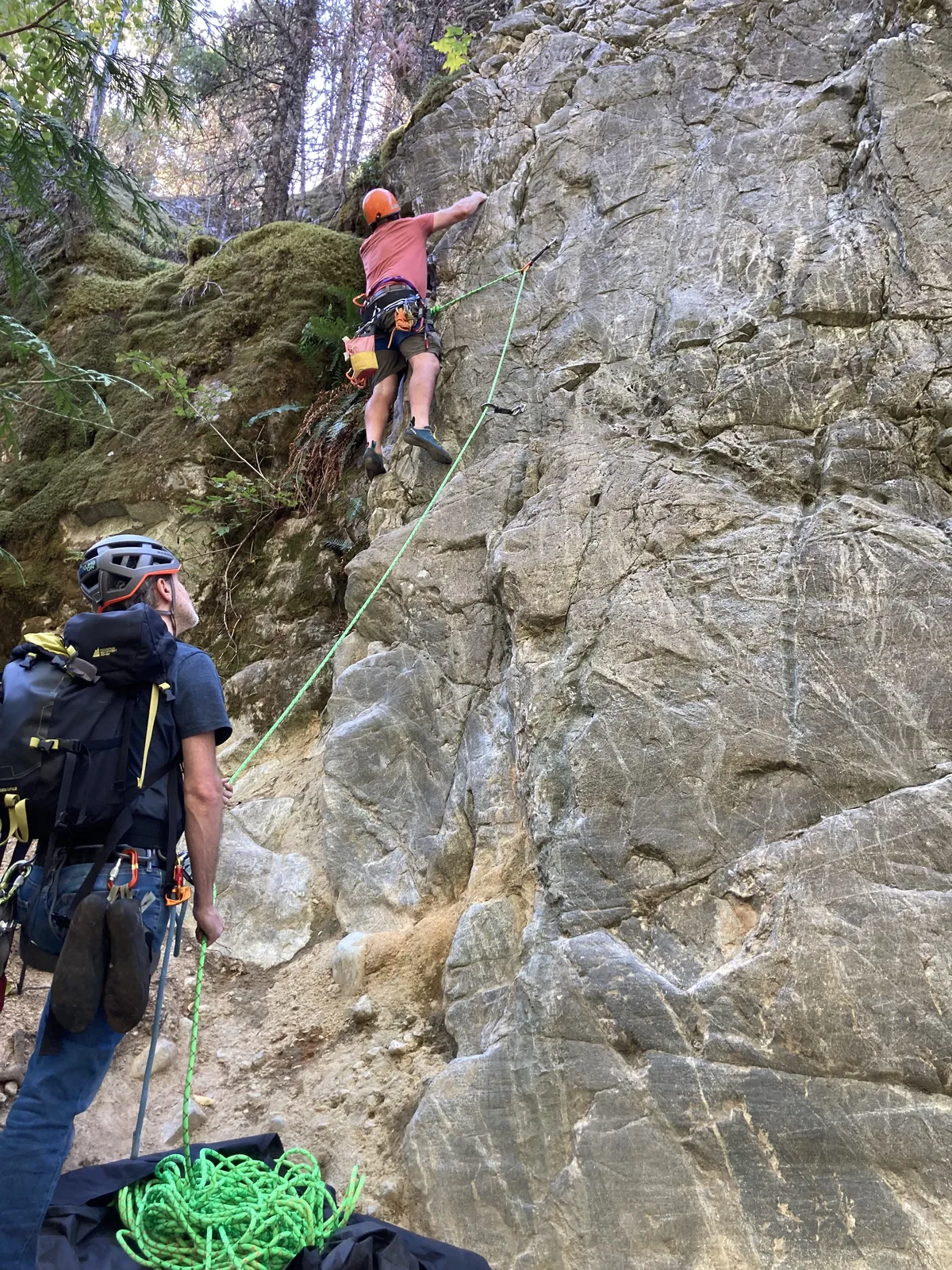
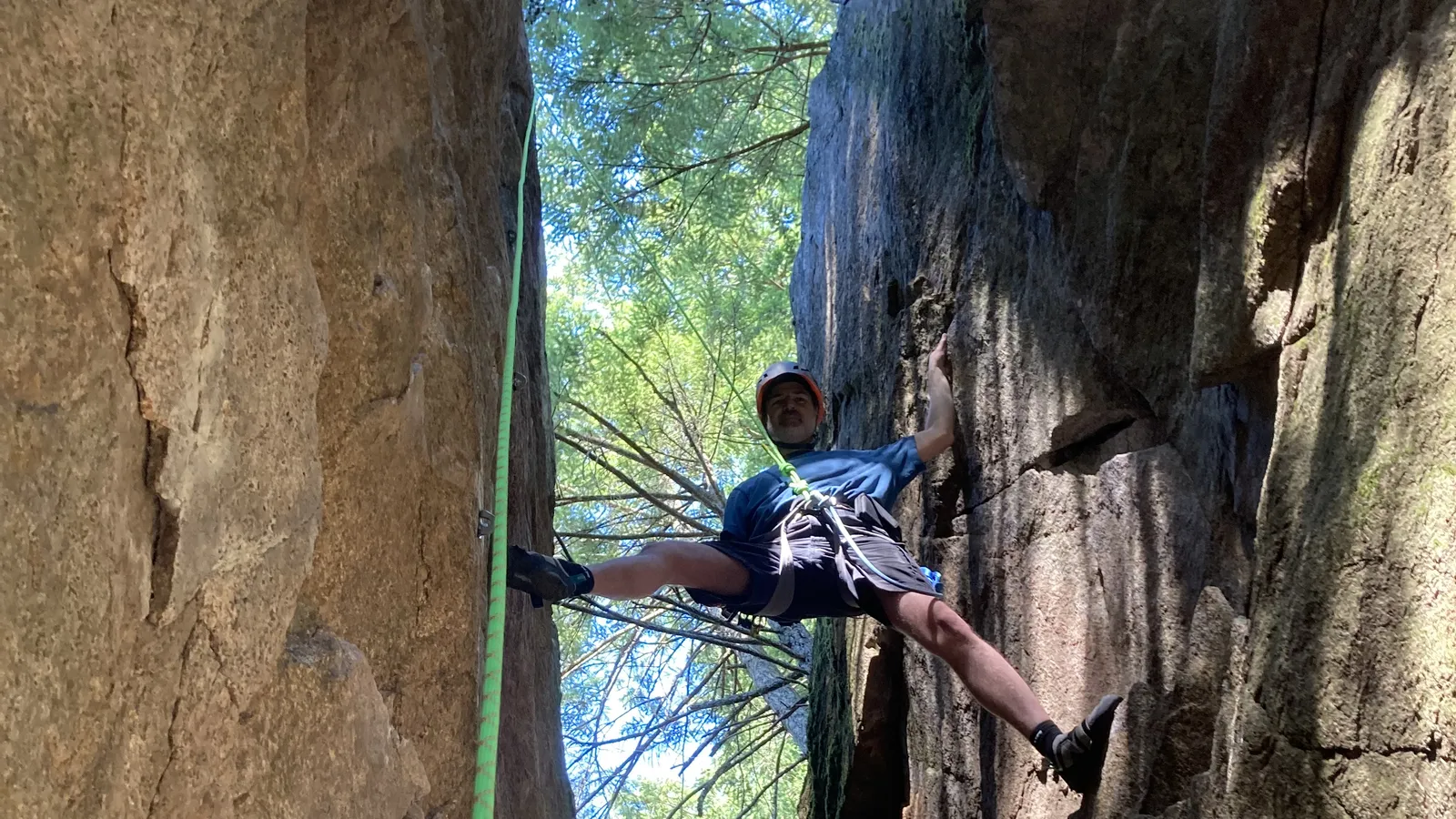
Climbing in Chek Canyon, north of Squamish. A few seconds after this photo was taken, I fell suddenly from the rock — and was caught with great finesse by my belayer, Brent.