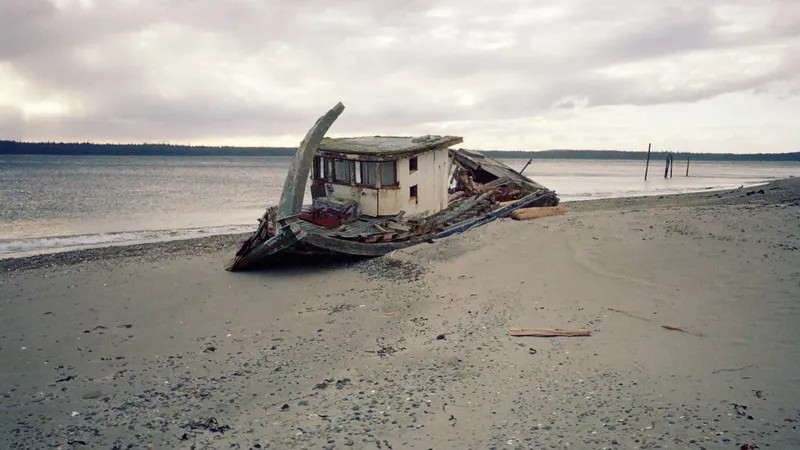
The Pattern of Departure
Toward the horizon, the broad limbs of a fir tree stretch out from a trunk still black against the morning sky. The indigo dawn brightens toward vermilion. A scatter of skeletal branches extends on the south side of the tree, high up. Beneath these and northward, a mass of counterbalanced foliage swings above the creek. Branches at the tangled summit render the shape of a bird in a nest. Perhaps it is a bird, not merely branches. At this distance it’s too hard to tell. The trunk slowly rocks in the freshening wind.
Lower down, stands of dense cedar and scrubby fir punctuate the rising landscape. The geography is spare in this light: hidden rills and derelict fences blend into the land’s soft, woolen texture. A scrim of cloud obscures the dawn for a moment, then moves off. Wind from the bay slides across hills warmed by the rising sun. I scan overhead, looking for the first wing-borne travelers of the day, but I do not yet see them. I hear a single call, far off and forlorn, but nothing more. Perhaps the tide is in flood along the crescent of the bay, and the submerged flats offer nothing yet for the black and scavenging birds to find. Perhaps they have been delayed by scattered rain along the lee of the hill.
I wait, and wonder where they come from. Somewhere in the northeast, that’s all I know—the direction of the mountains and the agricultural lands and a hundred other enclaves that might harbor their nests. Sometimes I consider trying to follow them at the end of the day, when they retrace their path in the darkening sky. But they travel diagonally, across the direction of the roads, and it has not seemed prudent to drive with my head out the window, gazing skyward. Then I see a black bird—yes, a crow—scuttling between green treetops along the ridge beside the creek. It glides, flaps into an updraft from the onshore breeze, glides again, then heads for the bay. Behind this outrider I glimpse a trio, loosely gathered, also flying shoreward. Then more birds appear: hundreds, perhaps thousands, in groups and flocks ordered and haphazard, all flying from the northeast, all following the same scent trail. Their wings beat rhythmically against the backdrop of the piebald sky.
Some are sleek and symmetrical, wings like aircraft. Others are colored with flecks of gray or spotted with white. I don’t know if these flecks are signs of disease; but the spotted birds are not noticeably less agile or slower than those with full and glistening black regalia.
The birds fly over for half an hour or more, an armada ghosting above the trees, low enough for me to watch the odd pair tumble and dive in what looks like simple play. Aside from these moments of jostling and jousting, the crows do not pause in their traveling or watch the ground or scavenge. They fly along unseen air currents above the creek, follow the ridge that surmounts the ancient bog, and glide across the flood plain that stretches across farmland and into the sea. They remain within the invisible boundaries of a narrow path in the sky that is perhaps a quarter mile wide. I have not seen them make their passage elsewhere: farther down the bay, south toward the marshlands, or north along the peninsula that steps into the deep waters of the strait. Other birds claim that territory. The crows of my mornings appear here only, south of the river, on high ground above the delta.
By the time the sun has fully risen the crows are gone. Other birds, small flitting flocks of local inhabitants, fly from tree to tree. But the crows have moved onward, toward their destination. And though I believe they seek the shoreline, the expanse of tidal flat exposed by the moon’s ebb, I have never seen them there. Along that shore I see great wheeling flocks of gulls and species of tiny, racing birds that move as one in groups of thousands. They cohere into convoluted shapes offshore: clouds, invisible winds, shape-shifting phantasms. Eagles rest on trees cracked open by lightning and rot, herons stand in the shallows or fly inland, languid on slate-colored wings. But I do not find the crows at the shore.
These morning migrations are more than natural spectacle. They reveal a fundamental pattern: the pattern of departure, of seeking elsewhere, of movement away from one place toward another that might offer what this place cannot. This is the geography of escape, and it manifests not only in the flight paths of crows but in the lives of those struggling with what I call elsewhere addictions—patterns of substance use, behavior, and consciousness that serve a singular purpose: to facilitate departure from the unbearable here and now.
These patterns have deep roots, often extending back to the earliest months and years of life, when a developing nervous system learns whether the world is safe, whether belonging is possible, whether presence invites connection or threat. When those early experiences teach that departure is safer than arrival, that elsewhere is more welcoming than here, a developmental vulnerability forms that can persist across the lifespan. Understanding this pathway—from early developmental disruption through trauma response to mental health adaptation to addiction—is essential for anyone working with people caught in the elsewhere pattern.
Understanding Elsewhere Through an Ecological Lens
When we experience trauma—particularly trauma that activates the flight response—our system learns to seek escape as a primary survival strategy. This isn’t a moral failing or a choice in any simple sense. It’s the system self-organizing around a solution that worked, at least initially, to preserve the organism.
Here’s the critical pathway that I’ve observed across years of clinical work, a pathway that connects trauma responses to mental health adaptations to addictive behaviors:
Developmental Disruption: Existence and Belonging → During the critical window from the second trimester through three months after birth (the Existence and Belonging stage in Bodynamic developmental theory), the infant learns whether the world is safe, whether their presence is welcomed, whether belonging is possible. When this stage is disrupted through prenatal stress, birth trauma, NICU care, parental mental health challenges, neglect, or environmental chaos, the infant learns that presence is dangerous and existence is precarious.
Trauma Response: Flight → Unable to physically flee (the fetus or infant lacks mobility), the developing nervous system discovers psychological flight: dissociation, absence even while present, the capacity to “leave” without going anywhere. This becomes the primary protective strategy, activated before language or explicit memory.
Mental Health Adaptation: Dissociation → Over time, this flight response becomes internalized as dissociation. The person develops the capacity to “leave” their immediate experience—to separate consciousness from the body, to observe from a distance, to split awareness from overwhelming sensation or emotion. Dissociation is initially adaptive; it allows survival in conditions that would otherwise be psychologically devastating.
Addiction: Hallucinogens and Other Escape Vehicles → When dissociation becomes a habitual mental state, substances and behaviors that facilitate departure become compelling. Hallucinogens, online worlds, geographic wandering, extreme spiritual practices—these aren’t just ways to cope with trauma. They actively maintain the flight response, keeping the system organized around departure. The addiction facilitates the continuance of the trauma response itself.
The addiction isn’t merely caused by trauma or even just a symptom of it. The addiction participates in maintaining the entire system in a state of perpetual flight—a self-reinforcing pattern that becomes increasingly stable over time. The system returns to this configuration again and again because all the constraints in the environment and within the person guide behavior toward this pattern.
Recognizing Elsewhere Addictions in Professional Settings
In workplaces, schools, and community settings, elsewhere addictions don’t always look like substance abuse. The pattern of flight can manifest in multiple ways, and professionals who work with people experiencing these patterns need to understand the diversity of presentation.
Hallucinogenic substance use—LSD, psilocybin, DMT, ayahuasca, and other consciousness-altering substances—may be framed as spiritual exploration or personal growth work, and indeed they sometimes serve that purpose. But when use becomes compulsive or when the person seems unable to remain in ordinary consciousness, when there’s an urgency to “get out” of normal awareness, we’re seeing the flight response in action.
Online and virtual worlds present another form. Gaming, social media immersion, virtual reality, and other digital escapes can consume excessive hours, often to the detriment of physical health, relationships, and responsibilities. The person becomes more present to the virtual than to the actual.
Geographic wandering—compulsive travel, inability to settle, serial relocation—can look like adventurousness or “having the travel bug,” but underneath may be flight from self and relationship. The person is always planning the next departure, rarely fully arriving anywhere.
Extreme spiritual seeking manifests as constant movement between practices, teachers, and traditions. A kind of spiritual tourism prevents deep engagement with any single path. The seeking itself becomes the escape.
Workaholism and achievement addiction can serve the flight response when they function to avoid presence, feeling, and intimacy—the person dissociates through busy-ness, always future-focused, never here. (When the same behaviors are driven by anxiety and hypervigilance rather than dissociation, they belong to the geography of motion.)
Intellectual dissociation means living entirely “in the head,” abstract theorizing, excessive analysis that prevents embodied experience and emotional connection.
Key indicators that you’re seeing an elsewhere pattern rather than healthy exploration or engagement:
- Compulsive quality: The behavior feels driven, urgent, non-optional
- Relationship avoidance: Pattern interferes with forming or maintaining intimate connections
- Physical disconnection: Person seems disembodied, not grounded, floating
- Temporal displacement: Always oriented toward past or future, never present
- Fragmentation: Sense of the person as scattered, not integrated, parts not communicating
- Urgency about escape: Anxiety or distress when escape routes are blocked
- Pattern persistence despite consequences: Continued behavior despite clear costs
A Journey Through Elsewhere: Joseph’s Story
Joseph is one of my clients (not his real name). When he enters the office, it’s as though he isn’t sure he wants to be there. His body language is tentative, prepared for retreat. This tentativeness extends to all of his relationships, all of his commitments. Joseph is a wanderer, though not in the literal sense of being homeless. He wanders through his own consciousness.
He tells me about his history with hallucinogens: LSD primarily, though he’s explored psilocybin, ayahuasca, and various synthetic compounds. He describes elaborate journeys into inner space, encounters with entities and visions, moments of transcendent understanding. His language is sophisticated, influenced by mystical literature and neuroscience. He can discuss receptor sites and shamanic traditions with equal facility. But beneath the articulate surface, I sense something else: a kind of desperate reaching, a need to be anywhere but here.
I ask him about his childhood. This is where the story deepens, and where the developmental roots of his elsewhere pattern become visible. Joseph grew up in a home marked by unpredictability and emotional violence. His father was volatile, explosively angry. But the volatility started earlier than Joseph consciously remembers. His mother told him, years later, that his father’s violence began during her pregnancy with Joseph—explosive rages that terrified her during the second and third trimesters. She lived in a state of chronic fear and hypervigilance during the exact period when Joseph’s nervous system was first organizing itself, learning at the most fundamental level whether the world was safe.
After Joseph’s birth, the violence continued and intensified. His father’s rage now focused on the infant’s crying, on the disruption Joseph brought to the household. His mother, already traumatized by months of living with violence and now coping with what was almost certainly postpartum depression, struggled to provide the consistent attunement and responsiveness Joseph needed during those critical first three months. She was there, physically present, but often emotionally absent—frozen in her own trauma response, unable to regulate her own nervous system let alone help regulate her infant’s.
This is the classic disruption of the Existence and Belonging stage: an environment of threat during the prenatal period when the nervous system is first forming, followed by caregivers who are present but unavailable during the first three months when foundational patterns of safety and connection are established. Joseph learned, at a somatic level before explicit memory or language, that his existence created problems. His presence in the family triggered violence. His needs overwhelmed his caregivers. The world was fundamentally unsafe.
The adaptive solution his developing nervous system discovered was departure—not physical flight (impossible for a fetus or infant) but psychological absence. Even in utero, exposed to maternal stress hormones, his system was learning patterns of dissociation. After birth, faced with a chaotic and frightening environment, these patterns deepened. He learned to be quiet, to need very little, to vanish into an inner state where he wasn’t a burden to anyone and wasn’t present to the threat around him.
By the time Joseph was a toddler and young child, this pattern was deeply established. He was the “easy” child, the one who never complained, who entertained himself for hours, who seemed content to be alone. His parents, relieved not to have additional demands, didn’t recognize that this apparent self-sufficiency was actually a developmental red flag. Joseph wasn’t securely attached and happily independent; he had learned that connection was dangerous and that his survival depended on not needing anyone.
Joseph discovered books early, fantasy worlds where he could live more fully than in his own family. He retreated into imagination, into elaborate inner landscapes. This capacity saved him—it gave him refuge—but it also deepened the dissociative pattern. By adolescence, Joseph had difficulty being present in his body, in relationships, in the moment. He felt like a ghost in his own life, which is precisely what his nervous system had trained him to be.
When he first tried LSD at age seventeen, it wasn’t just a recreational experiment. It was coming home to a state he already knew—the state of being elsewhere. The drug formalized and intensified his existing dissociative capacity, which had roots in the earliest months of his life. The hallucinogen didn’t create the flight response or the dissociation; it simply provided a chemical means of accessing and amplifying what was already his primary way of being in the world.
This developmental understanding reframes Joseph’s hallucinogen use entirely. He’s not seeking pleasure or recreation or even spiritual insight, though these may be present. He’s maintaining a protective pattern that formed when he was too young to have any other options. The addiction facilitates the continuation of the flight response that kept him safe when he was an infant in a chaotic, terrifying home. His system learned: belonging is dangerous, presence invites violence, existence creates problems. Better to not quite be here.
Over many years, Joseph’s hallucinogen use became the central organizing principle of his life. He structured his work (he’s a freelance designer) to accommodate extended trips. He sought out communities of psychedelic explorers. He read voraciously about consciousness expansion. But he couldn’t maintain relationships. Partners would eventually leave, frustrated by his inability to fully arrive, to be present with them.
This makes perfect sense given his developmental history. Joseph learned in infancy that being fully present with another person was dangerous. Connection meant exposure to violence and neglect. His nervous system, brilliantly adaptive, learned to protect him through absence. Every relationship in his adult life activates this early learning. When a partner gets close, when intimacy deepens, Joseph’s system interprets this as threat. The flight response activates. He reaches for the substances that will take him elsewhere, that will maintain the protective distance his nervous system still believes he needs.
This is the elsewhere addiction in its clearest form. Joseph’s system learned that flight equals safety. Dissociation became his primary mental adaptation, and hallucinogens became the technology that kept the entire pattern active and stable. Each trip reinforced his capacity for departure, validated the idea that here was less real or less valuable than there, and made ordinary consciousness feel increasingly intolerable.
In dynamical systems terms, Joseph’s pattern is what we call an attractor state. His psychological system has organized itself around departure, and multiple constraints—internal and environmental—guide him back to this configuration repeatedly. The trauma of his childhood created initial conditions that favored flight. His natural intelligence and imagination provided resources for elaborate dissociative experiences. The cultural valorization of psychedelic exploration provided social reinforcement. His work flexibility removed practical constraints that might have limited use. All of these factors combined to create a stable pattern that resists change—not because Joseph lacks willpower or insight, but because the entire system is organized to maintain it.
This is why traditional interventions often fail with elsewhere addictions. Telling Joseph to “just stop using” or to “be more present” doesn’t address the systemic nature of the pattern. The flight response is deeply embedded. Dissociation is automatized. The substances have become integrated into his identity and his understanding of reality itself.
Joseph came to therapy after his third partner left—the same pattern, the same words: You’re not here. I can’t reach you. He arrived tentative, prepared for departure even in the consulting room. What allowed him to stay, over months and then years, was not insight or technique but patience: I did not require him to arrive before he was ready. I let him come and go within our sessions, let him describe his journeys without judgment, let him test whether this particular relationship could tolerate his pattern of absence. Gradually, the room became a place where he could practice presence in small doses—a few minutes of eye contact, a moment of noticing his body in the chair. The relational container—the accumulation of small moments in which nothing catastrophic happened—had to be established before any intervention could take hold. This is almost always true with elsewhere addictions: the therapeutic relationship itself must become a place where arrival feels possible.
The Environmental and Relational Context
Understanding elsewhere addictions requires attention to the full ecological context—not just the individual’s internal experience but the environment that shapes and constrains behavior. In Joseph’s case, several contextual factors maintain his pattern:
His work context offers maximum flexibility and minimum accountability. Freelance design work allows Joseph to disappear for days without consequence. While this freedom might be beneficial for someone with different needs, for Joseph it removes a key constraint that might otherwise limit compulsive use.
His primary community consists of other psychedelic explorers. This provides belonging but also reinforcement of the departure pattern. There’s little modeling of or support for being present, grounded, or relationally engaged.
Joseph lives alone in a small apartment with minimal anchoring features—few photographs, little art, sparse furniture. The environment itself lacks affordances for presence and connection. It’s designed, perhaps unconsciously, to be easy to leave.
He organizes time around his trips. Ordinary life fills the spaces between journeys. This creates a hierarchy where departure is primary and presence is secondary, maintaining the pattern at a structural level.
From an ecological dynamics perspective, these aren’t separate factors that contribute to Joseph’s addiction. They’re part of a unified system that includes Joseph’s nervous system, his habits of consciousness, his social relationships, and his physical environment.
Change will require working at multiple scales simultaneously—not just changing Joseph’s internal experience but also modifying the environmental constraints and affordances that shape his behavior.
The Affordances of Escape: What Elsewhere Provides
Elsewhere addictions provide relief from overwhelm. When the present moment contains too much sensation, emotion, or complexity, departure offers relief. The system downregulates through absence rather than integration.
They protect against relationship. Intimacy requires presence and vulnerability. For those whose early relationships were dangerous, departure protects against the threat of connection.
They afford access to meaning and transcendence. Elsewhere experiences often feel spiritually significant, providing a sense of meaning that ordinary life may not offer. This isn’t illusory—altered states can reveal genuine insights—but when this becomes the primary source of meaning, the person becomes dependent on departure for existential sustenance.
Each successful escape validates the flight response, confirming the nervous system’s learning that flight equals safety. The pattern deepens.
For many, their capacity for and experiences with elsewhere become central to their identity. They’re “the person who’s done ayahuasca twelve times” or “the digital nomad.” Their community recognizes and values this identity.
While elsewhere addictions ultimately maintain trauma responses, they also provide temporary relief from trauma symptoms. The dissociation reduces intrusive memories, hypervigilance, and emotional flooding. This is powerful negative reinforcement.
We can’t simply remove the addiction without addressing the problems it solves. If we take away someone’s primary means of managing overwhelm, protecting themselves from relationship, accessing meaning, and regulating trauma symptoms, we leave them worse off than before. Recovery must involve discovering alternative solutions to the same problems—solutions that don’t require departure.
Developmental Origins: Existence, Belonging, and the Flight Response
Early developmental trauma creates vulnerabilities—not deterministic causes, but genuine predispositions—for later struggles with substance use and mental health. The elsewhere pattern has deep developmental roots in what Bodynamic Somatic Developmental Psychology calls the stage of Existence (or, more broadly, Existence and Belonging)—a critical period extending from the second trimester of pregnancy through approximately three months after birth. This foundational stage, though brief in calendar time, has profound and lasting impacts on nervous system organization.
During this period, the developing organism learns at the most fundamental level whether the world is safe, whether existence is welcomed, whether they have a right to be here and belong in this particular family and community.
When this stage proceeds well—when the prenatal environment is stable and the postnatal caregiving is consistently available, attuned, and responsive—the infant develops a fundamental sense that they belong here, that their existence is welcomed, that the world is a place where they can safely arrive and be held. Their nervous system learns at a pre-verbal, somatic level that connection is safe and that presence is possible.
But when this stage is disrupted—through prenatal stress, maternal trauma during pregnancy, birth complications, premature birth, neonatal intensive care, early hospitalization, parental depression or absence in the first three months, adoption or foster placement, or other forms of early rupture in the foundational relationship—the developing organism faces an impossible situation. The nervous system is forming its most basic patterns of organization during this period, learning whether the world is fundamentally safe or threatening.
When the answer is threatening, when existence feels precarious and belonging uncertain, the nervous system’s brilliant adaptive capacity organizes around departure: absence as protection, the capacity to not be here even while physically present.
This is not a conscious choice. An infant cannot decide to dissociate. But the nervous system can learn, at a pre-verbal and deeply embodied level, that safety lies in absence rather than presence. The flight response becomes embedded as a primary protective strategy, activated long before language or explicit memory.
Research on adverse childhood experiences shows us that:
- Children who experience early separation, neglect, or disrupted attachment show higher rates of dissociative symptoms later in life
- Early instability in caregiving creates vulnerabilities for difficulties with presence, embodiment, and relational engagement
- The earlier the disruption occurs, the more foundational the impact on nervous system organization
- Multiple or prolonged adverse experiences compound vulnerability
- These patterns persist across the lifespan unless intentionally addressed
It’s important to understand these are vulnerabilities, not destinies. Many people who experience disruptions in Existence and Belonging do not develop elsewhere addictions. Many find healing through subsequent relationships, through their own internal resilience, through circumstances that support nervous system reorganization. But the vulnerability remains, particularly when later stressors activate the original flight response.
Consider the common developmental experiences that create vulnerability for elsewhere patterns during the Existence and Belonging stage. Prenatal stress and trauma—maternal stress, trauma, substance use, or domestic violence during the second and third trimesters—directly impacts the developing fetus’s nervous system. The organism learns, in utero, whether the world is safe or threatening.
Birth complications create early vulnerabilities. Traumatic birth, emergency C-section, premature birth, or other complications create early stress or separation between mother and infant during the critical first hours and days. When infants require neonatal intensive care, they experience separation from parents, painful medical procedures, and an environment of machines and alarms rather than the expected warmth of maternal holding during their first days and weeks of life. Hospitalizations, surgeries, or medical procedures during the first three months create associations between physical existence and pain or threat.
Even when occurring shortly after birth, adoption represents a fundamental rupture—separation from the biological mother whose rhythms, voice, and presence the infant has known since the second trimester. The nervous system experiences this as existential threat.
Parental mental health challenges during the first three months create disruption. Maternal postpartum depression, anxiety, or other mental health challenges mean the caregiver is physically present but emotionally unavailable during the exact period when the infant’s nervous system is learning whether connection is safe.
Death, illness, incarceration, or other circumstances that remove a primary caregiver during these first critical months create rupture and uncertainty. When basic needs for touch, holding, responsiveness, and attunement go unmet during the first three months, the infant’s existence feels unacknowledged. They learn they don’t quite belong.
Domestic violence, substance use, housing instability, or other environmental threats during this period communicate to the developing nervous system that the world is fundamentally unsafe.
These early experiences create what we might call a “developmental predisposition” toward the flight response. When stress arises later in life—and it always does—the person’s nervous system reaches for the strategy it learned first: departure. Not physical flight (though that sometimes occurs), but psychological flight through dissociation.
This dissociative capacity, learned in infancy and refined through childhood, becomes the foundation for later elsewhere addictions. The person discovers that substances, behaviors, and practices that enhance dissociation feel familiar, even comfortable. Hallucinogens don’t teach them to leave; they already know how to leave. The substances simply formalize, intensify, and make more explicit a pattern that has been organizing their experience since before language.
This helps explain why elsewhere addictions are so resistant to traditional interventions. We’re not just addressing a substance use problem. We’re working with a pattern that has roots in the earliest organization of the nervous system—literally beginning before birth—that served genuine protective functions, that has become integrated into identity and relational style, and is maintained by multiple reinforcing systems. The addiction is the visible tip of a much deeper developmental-neurological-relational pattern.
It also explains the immense courage required for recovery. For someone whose nervous system learned, beginning in utero and continuing through the first three months of life—before language, before explicit memory, at the most foundational level of somatic organization—that belonging is dangerous and departure is safety, choosing to be present requires overriding the most fundamental protective strategy they possess. It’s not about willpower or motivation. It’s about nervous system reorganization at the deepest possible levels.
This developmental understanding should infuse all our work with elsewhere addictions with humility and compassion. The person sitting before us, struggling with compulsive hallucinogen use or unable to log off from virtual worlds or perpetually planning their next geographic escape, is not weak or undisciplined. They’re carrying a developmental vulnerability that made perfect sense given their early circumstances. They’re using the only tools they’ve found to manage what has always felt unmanageable: the terror of arriving, the danger of belonging, the overwhelm of fully existing here.
The Myth of the Sirens: Constraints and the Failure of Willpower
In The Odyssey, long before Odysseus finds his way home, he and his crew are forewarned that they will pass the island of the Sirens. The singing of those celestial voices will cause all who listen to be overcome with longing and be forever lost. Circe the witch tells Odysseus that he must insert wax into the ears of his crew to protect them from this enchantment. And she permits him to be bound to the mast, so that he might hear that siren call but be prevented from casting himself upon the shore.
The wind stalls as Odysseus and his crew approach the island. The sea grows calm. The men stow the sails in silence and take up great oars, churning the water into foam as they draw upon the blades. Then, on the deck, assisted by the sun’s warmth, Odysseus kneads small lumps of wax and places them in the ears of his crew. They lash him to the mast as the ship rounds the point upon which the Sirens stand surrounded by the bones of the dead.
The Sirens sing to Odysseus: of longing, of a home lost to the wanderer, of glory and of peace. Their song uncoils over the corpses on shore, across the water, and lays Odysseus bare to enchantment. And he is overcome. Shouting, he pleads for his companions to free him. The ropes chafe him as he strains upon the mast. But the crew do not release him, nor do they join him. They are deaf to the siren song, and when they see Odysseus struggling in his bonds, two of the crew leave their oars to tighten the ropes.
The ship sails past the green headland with its macabre decorations. The Sirens sing on, but their voices dwindle with the distance, and the last Odysseus hears of them is this:
No life on earth can be hid from our dreaming.
The crew row onward, until the island falls beneath the horizon, until Odysseus no longer calls out for release. Finally, they rest upon their oars, remove the wax from their ears, and free their captain.
This narrative teaches us something essential about elsewhere addictions: willpower alone is insufficient. Odysseus, the greatest hero and wanderer of ancient myth, a man renowned already in legend while he still lived, was powerless in the face of the Sirens’ call. He would have surrendered his life, and those of his crew, to the haunting song. It’s an impulse typical not only of hallucinogen users, spiritual seekers, and addicts of the online elsewhere, but of human nature itself: to let go and fall into enchantment.
From an ecological dynamics perspective, Odysseus’s strategy is instructive. He doesn’t rely on his own strength or discipline. Instead, he modifies the constraints. The ropes physically prevent him from acting on his impulse. The wax prevents the crew from hearing the call. These are environmental constraints—external structures that make certain actions impossible.
The crew serves as a constraint system, actively maintaining Odysseus’s bonds even when he begs for release. They provide the relational structure that holds when individual willpower fails.
The strategy depends on moving through the dangerous zone. The constraints only need to hold for a limited time, until the ship passes beyond the Sirens’ range.
This is how we must think about working with elsewhere addictions. We need to create constraint systems—environmental modifications, relational structures, temporal boundaries—that support the person when their own regulatory capacity is overwhelmed by the call of departure. Asking someone to resist through willpower alone is asking them to do what even Odysseus could not.
Pathways to Presence: Working with Elsewhere Addictions
Given everything we’ve explored about the ecological dynamics of elsewhere addictions, what can professionals actually do? How do we support people whose systems are organized around departure to discover possibilities for arrival?
First, we must see elsewhere addictions for what they are—not moral failures or simple substance abuse problems, but complex adaptive patterns with developmental roots. Dissociation was adaptive. The addiction maintains a system that once protected the person. Our work begins with this recognition and the compassion it enables. When we understand that the person sitting before us learned before language that belonging was dangerous and departure was safety, we can approach with humility rather than judgment.
Take time to explore the person’s early history, particularly the prenatal period and first three months of life (the Existence stage in Bodynamic developmental theory). What was happening during the pregnancy? Was there maternal stress, trauma, substance use, or domestic violence? Were there birth complications, premature birth, or NICU care? What were the first three months like? Was a parent depressed, absent, or struggling? Were there early separations (adoption, foster care, hospitalization)? Was the early environment chaotic, unpredictable, or frightening? Did the family system communicate, implicitly or explicitly, that the infant’s existence was problematic or unwelcome?
Understanding the developmental origins—particularly recognizing that these patterns often formed before explicit memory, even before birth—helps us recognize that we’re not just treating a substance use problem but addressing vulnerabilities that formed when the nervous system was first learning how to be in relationship with the world. This understanding should infuse all our interactions with patience and recognition that change requires nervous system reorganization at the most foundational levels.
Change requires intervention at multiple levels simultaneously. At the individual/neurobiological level, we use trauma-informed approaches that address the flight response and build capacity for presence and embodiment. Relationally, we create relationships that afford safe connection without demanding premature intimacy. Environmentally, we modify spaces and schedules to provide more affordances for grounding and fewer opportunities for compulsive departure. We help build or access communities that value presence and provide alternatives to elsewhere-focused peer groups. We help the person discover sources of meaning and transcendence that don’t require departure.
Like Odysseus’s ropes and wax, sometimes people need external structures that make departure more difficult: scheduled check-ins and accountability relationships, removal or limiting of access to substances or devices, structured environments with built-in presence-supporting activities, time constraints that limit the duration of escape behaviors. But constraints must be collaboratively designed and experienced as supportive rather than punitive. They work best when the person understands and consents to them as helping structures rather than experiencing them as imposed controls.
The elsewhere pattern often persists because the person lacks alternatives that meet the same needs. We must create affordances for safe, non-demanding connection (animals, nature, art, gentle movement practices), embodied experience without overwhelm (somatic practices, breathwork, gentle yoga), meaning-making that doesn’t require altered states (ritual, service, creative expression), and transcendent experience in ordinary consciousness (practices that cultivate wonder, attention to beauty, contemplative practices).
These affordances require access many people do not have. Trauma-informed therapy requires a therapist, which requires money or insurance or geographic proximity to services. Somatic practices require a body not already exhausted by survival. Contemplative communities require the safety to sit still, which requires housing, which requires resources. The person sleeping rough, the person working three jobs, the person in an abusive relationship that controls where they go—these are not minor barriers that can be overcome through motivation. They are structural constraints that shape what is possible.
For those whose circumstances make the recommendations in this chapter feel unreachable, I want to name that directly: you are not failing. You are living within constraints that limit your options, and those constraints are real. What might be possible at a smaller scale—a single breath taken with attention, a moment of noticing a patch of sky between buildings, the texture of your own hand—may be the only affordance available right now. The principle remains: the nervous system can learn presence in small increments. But the application must meet people where they actually are, not where we wish they could be.
People organized around flight cannot simply decide to be present. Presence is a skill that must be developed incrementally. Start with very brief moments of presence (seconds, not minutes). Use anchors (breath, sensation, sound) that provide something concrete to return to. Practice in safe contexts before attempting presence in challenging situations. Celebrate small successes rather than focusing on the enormity of the overall pattern.
Ultimately, elsewhere addictions persist because the flight response remains active. Working with the original trauma—not necessarily through explicit trauma processing, but through approaches that help the nervous system learn that safety is possible—is essential for long-term change.
Remember degeneracy. What works for one person may not work for another. Stay curious about each person’s unique configuration of constraints and affordances. Be willing to experiment. Be humble about your predictions.
Recovery from elsewhere addictions rarely happens through abstinence alone. The person needs time to discover what presence offers, to build tolerance for being here, to develop alternative patterns. Think in terms of creating transitions rather than demanding sudden stops.
The Two Tasks of Recovery
Two basic healing tasks lie before the recovering hallucinogen user or addict of elsewhere. The first is to find the ecstatic in daily life: in grounded meditations, in the garden, in the tasks of intimacy and stewardship. It doesn’t matter much what they choose, so long as it connects them to people. Sure, people are awkward and troublesome, but traveling with them is the only path to authentic fulfillment. The second healing task is to discover a means of sharing their imaginative and spiritual capacities, of delivering their visions to the community fireside. They don’t need drugs or trances to do this: they already know how to row. They came into the world that way, rowing for the shore, not quite finding it, heading back out again.
Sometimes Joseph and I speak about him finding the shore. It’s as though people wave to him from there, calling him in. They’ve been calling for a long time. They’ve set watchfires, and have made a clear channel to protect his craft from the shoals. A child writes his name in the sand. All that is required of him is that he turn his tiny craft, face the horizon of elsewhere, and row shoreward.
This turning, this reorientation toward presence rather than departure, is the fundamental shift. It happens when the entire system—nervous system, environment, relationships, meaning-making—reorganizes around a different attractor. When presence becomes more stable than absence. When here becomes more compelling than elsewhere.
Our role as professionals is not to force this turning but to create conditions where it becomes possible. To be the fires on the shore, calling the person home. To help clear the channel of its obstacles. To hold steady in our own presence so that the person can learn, gradually, that arriving is possible.
For some people, the shore never comes into view. They try the grounded meditation, the garden, the tasks of stewardship. They seek community and work with therapists who understand the pattern. They do everything this chapter suggests—and the call of elsewhere remains louder than the pull of presence. The flight response, learned so early and reinforced so long, does not quiet.
If you are one of these people, or if you work with someone who is: this is not failure. Some nervous systems are organized at such depth that reorganization requires more time, more resources, or more relational safety than is currently available. Some people will manage the flight impulse rather than dissolve it. Some will find partial presence—here for moments, elsewhere again, returning—and that oscillation may be the best that is possible in this lifetime. Healing is not one path. The goal is not perfection but continued movement toward what presence can be found, in whatever increments the system can tolerate.
The Storm and the Shore
The autumn storm has the flavor of duende, a wild turbulence of rain and hoary wind and cedar boughs torn and tumbling in the air. A gull rides downwind, moving at twenty knots or more, its neck feathers ruffled. Most of the birds are hunkered down in shallow dells, or in nests near the stream, or in barns among the fields. Offshore, the shallow sea is white with foam. Farther out, where the strait deepens, the swells are perhaps a dozen feet high. Part of me wishes I was out there, riding a windsurfing board or a sailing dinghy, joining the intensity and vitality of it. Such sports can indeed be hallucinogenic and spiritually fulfilling, every bit as good as ayahuasca and much better than eighteen hours of online gaming. Such experiences are capable of distilling vibrancy from the background noise and turbulence of daily life. They lead away from the quotidian and toward the experience of wonder. During storms, one might glimpse clearly the spirits of the sea.
But I consider my experience with such excursions: the danger, the cold, the scars on my leg and head and hands from reckless journeys at sea. I hear that call, the dreaming of the siren song, but I will not follow it today. Too often have I followed it, toward harm to myself and others. Sometimes a taste of death permeates the ecstatic. Today I will walk on the shore with my wife. We will lean into each other in the face of the wind. The crescent bay to the southeast is a blur of cobalt cliffs and gray clouds shredding. A bald eagle perches on a swaying tree nearby, close enough that we can see the taut tendons holding its talons to the wood. The bird gazes indifferently upon us as we pass.
We sidestep hummocks of wind-borne kelp blown onto the path by the storm. Wet shards of the stuff are scattered among the blue-tinged stones, now dark with rain, that demarcate the path. A trickle of muddy water meanders across the gravel, snakes down the hill with its slick and unruly vegetation, and empties into the canal dug in the lee of the dike by farmers a century ago. I follow the descending runoff with my eye: toward the bracken-filled canal, into the sluggish stream that empties the waters into the bay. On the far side of the stream, a field of ripened and now moldering pumpkins—mud-spattered, thick roots entangling—spreads toward the old airfield.
And there they are: the crows of my mornings. Slicing with their beaks into pumpkins, fashioning impromptu jack-o’-lanterns. Black wings flutter. The crows gorge, scrabble, take flight for brief spells in the blustering wind. Theirs is a celebration of homecoming, of defiance of the earth’s parceling. They possess the land as it possesses them. Along the old road and in the field of feasting, their clan has found its own belonging, each to each.
This is what recovery looks like: not the elimination of the flight impulse, not the complete dissolution of the capacity for departure, but the discovery that here—this muddy field with its rotting pumpkins, this storm-blown shore with its scattered kelp, this ordinary moment with its particular textures—can provide what we thought we could only find elsewhere. The crows haven’t stopped being birds of migration and movement. But they’ve found a place where they can feast, where they belong, where they can be together.
For the addict of elsewhere, recovery means learning what was never learned in infancy: that belonging can be safe, that presence is survivable, that existence doesn’t create problems but solves them. It means the nervous system discovering, perhaps for the first time, that connection doesn’t inevitably lead to violence or neglect or abandonment. Arrival doesn’t require departure. Being fully here, in this body, in this relationship, in this moment, is not only possible but can be the source of the very experiences—meaning, transcendence, connection, peace—that were sought elsewhere.
This is developmental healing at its deepest level. Dissociation, once necessary for survival, can give way to integration. The addictive pattern, once the only solution to impossible problems, can be released as new solutions emerge—solutions rooted in the discovery that this world, this body, this life, this community can be home.
The wanderer finds the shore. The flight response quiets. Presence becomes possible. The nervous system learns a new truth that contradicts its earliest learning: I belong here. I can stay. I am safe.
This is the work we’re called to as professionals supporting people with elsewhere addictions: to help create the conditions where presence becomes more stable than absence, where here becomes more compelling than elsewhere, where the person can discover that they’ve been seeking home all along—and that home has always been available, here, in the ordinary miracle of arrival.
For Further Reflection
As you work with people whose patterns suggest elsewhere addictions, consider:
- What developmental experiences might have created vulnerability for the flight response? Were there disruptions in the Existence and Belonging stage?
- How might early experiences with connection and presence inform current difficulties with arrival and engagement?
- What environmental constraints currently support the departure pattern? Which ones might be modified?
- What affordances for presence and connection are available in this person’s life? What new affordances might be created?
- How does the trauma history inform the current pattern? What does the flight response protect against?
- What community or relational structures might serve as supportive constraints when individual willpower fails?
- What small changes in the overall system configuration might create possibilities for reorganization?
- How can you honor this person’s capacity for imagination, transcendence, and altered states while helping them discover that these capacities don’t require departure?
- What would it mean to help this person’s nervous system learn, perhaps for the first time, that belonging is safe and presence is possible?
Remember: you’re not trying to fix the person or eliminate the pattern through force. You’re participating in a complex adaptive system, creating conditions where reorganization becomes possible. Like the crows in the pumpkin field, you’re helping the person discover that what they’ve been seeking elsewhere might be available here, in this moment, in this life, among this particular community of care.
The wanderer can find their way home. The work is to hold the possibility steady, to be the fire on the shore, to wait with patience and compassion for the moment when the system reorganizes and the person turns toward arrival.
Even his griefs are a joy long after to one that remembers all that he wrought and endured.
This page is part of the Practice Guide for Therapists