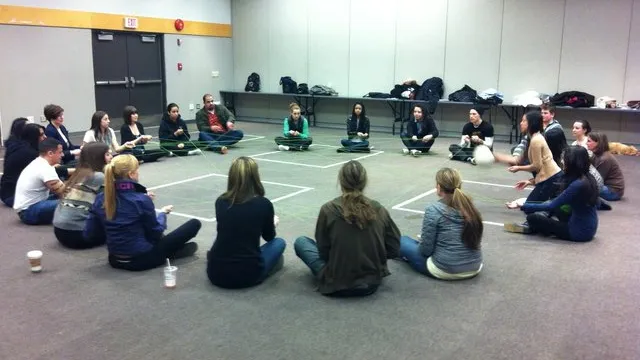
Trauma-informed describes an ethical and clinical framework for ensuring the safety and well-being of people who are involved in any aspect of trauma expression, recovery, healing, and social justice initiatives that address traumatic themes. Because these themes have diverse impacts upon the social and relational ecologies of museums, knowledge development for trauma-informed practices should include peers, colleagues, and leaders at every level. The Collections staff member handling residential school artifacts needs trauma-informed skills. So does the researcher conducting oral histories. So does the visitor services staff member who greets a residential school survivor at the door. So does the curator designing an exhibition about genocide. So does the executive making decisions about resource allocation. The skills look different in different roles, but they share common foundations: self-awareness, empathy, presence, and understanding of how trauma works in the body and the nervous system.
Trauma-informed practice is not something we learn once and then possess. It requires ongoing attention, practice, and renewal. It means learning to notice our own activation—the moment when a visitor’s story or a colleague’s distress begins to resonate with our own unresolved material. It means developing strategies for staying grounded when emotions run high. It means knowing when to step in, when to step back, and when to ask for help. All of this takes time, patience, and a willingness to keep learning.
The Personal Dimension
Professional development training usually means acquiring knowledge about facts, processes, and features of the outside world. Self-reflection, emotional awareness, empathy, and personal insight are not usually part of workplace training. Trauma-informed training is—must be—different. Trauma is personal, rooted in evolution, and tied to our emotional lives in ways that cannot be separated from who we are. Our reactions to our personal traumas, and to the traumas of others, always evoke our own inner landscape of feelings, perspectives, and reactions.
Trauma-informed workplace training must account for these personal reactions and help participants navigate what can often be a bewildering set of emotions and resulting behaviors. In most workplace settings, simply talking about feelings has historically been fraught with danger. The feelings surrounding trauma can be among the most powerful emotions we carry; handling them safely must be central to this training.
Why Personal Work Is Essential: How Early Experience Shapes Capacity
Understanding why trauma-informed training requires personal work—not just knowledge acquisition—becomes clearer when we understand how early experiences shape capacity itself. The patterns of reactivity, the difficulties with regulation, the triggers and vulnerabilities that staff bring: these are not character flaws or lack of professionalism. They are the result of how people’s systems organized during development.
During the first years of life, the body’s stress response system is being calibrated—learning how to respond to threat, how quickly to return to calm, how much pressure can be tolerated before overwhelm sets in. When a child experiences chronic stress without adequate support, this system develops heightened sensitivity. It may become overly reactive, treating minor stressors as major threats, or it may become blunted, shutting down after prolonged activation. These early calibrations persist across the lifespan, creating vulnerability to depression, anxiety, and difficulty managing the emotional demands of trauma-informed work.
The capacity for emotional regulation develops through thousands of repetitions: the infant experiences distress, the caregiver responds, the infant is soothed, calm returns. Through this process—called co-regulation—the nervous system learns how to regulate itself. When co-regulation is inconsistent or unavailable, the capacity for self-regulation develops incompletely. The pathways that should have been built during early years remain underdeveloped.
Early relationship patterns also become templates. Responsive caregiving creates an expectation that reaching out brings response, that others can be relied upon for comfort and support. Inconsistent or unavailable caregiving creates different expectations: either anxious preoccupation with relationships and fear of abandonment, or dismissal of relationship needs as protection against disappointment. These templates shape how people approach relationships throughout life, including relationships with colleagues and visitors in the museum.
The implications for trauma-informed training: staff are not blank slates. They bring systems that were shaped during critical developmental periods—systems that may have been calibrated for threat, that may struggle with regulation, that may carry relationship templates built around mistrust or avoidance. These patterns are not insurmountable, but they cannot be addressed through intellectual learning alone. They require personal work: therapy, somatic practices, ongoing self-reflection, and the slow process of allowing new experiences to reshape what was formed early.
This is why trauma-informed training emphasizes self-awareness as the foundation. Staff need to understand their own developmental histories, recognize how early experiences shaped their current patterns, and engage in the personal healing work that allows them to be present with others’ distress without being overwhelmed by their own.
Museums can support this personal work by providing access to Employee Assistance Programs or counseling services, protecting time for staff to engage in therapy or somatic practices, creating peer support systems where staff can reflect together, and normalizing the reality that this work affects everyone and seeking help is expected rather than exceptional. Without these institutional supports, asking staff to do personal work while providing no resources or time becomes an unfair burden.
When participants experience a sense of belonging, trust, and emotional safety, the training becomes safe and meaningful—and often therapeutic, though it is neither counseling nor therapy. Participants begin to understand that the work of trauma-informed practice starts with them, with their own inner landscape, before it extends outward toward others.
Skilled Persons
In professional environments of strong emotion and uncertain pathways, personal skills determine the outcomes. Those skills include, most fundamentally, self-awareness and empathy: how we stay in touch with ourselves and how we respond to others. These abilities require constant attention, reinforcement, and renewal. Effective personal skill also requires grounding, presence, self-regulation, containment, listening, and boundaries. And these, in turn, depend on the strategies we use to determine when and how we communicate and interact with others.
Body language, voice tone, language, timing, pacing, and waiting all play important roles in challenging situations. If we misjudge or overlook one of these factors, the whole situation can escalate or fall apart. Getting it right is hard—and is the reason we use the word wisdom in describing people who manage these complexities with grace and consistency.
Effective trauma-informed training means developing the skills needed to understand ourselves and engage with others, as well as strategies for situations shaped by the emotional reactions of other people (which is, actually, most situations). The training must provide space for practice, for feedback, for experimentation. It must normalize difficulty and uncertainty. It must create conditions where people can try skills, falter, receive support, and try again.
Personal First
Trauma-informed practices are not skills that we only apply to others in situations of stress or overwhelm. They are skills that we must first learn to apply to ourselves before we enter situations with others. If we miss this step, we risk harming both ourselves and other people.
The tactics we use in charged situations are based on, and must emerge from, our self-awareness. The strategies we use to navigate moments of emotional uncertainty are grounded in our own grounding. The dynamics that emerge between us and other people are built upon our attunement to our own feelings, thoughts, and reactions. This is all work of the self: personal, perhaps vulnerable, always delicate.
Training must emphasize the importance of emotional safety for participants. They need to feel that they can be themselves, that they can explore and apply these skills in their own unique ways. There are no precise formulas or recipes in this work. Everyone is different and must find their own way through practice, helpful feedback, and collegial support. The skills and strategies of working with people don’t come from outside. They are work of the inner life.
Why Intellectual Knowledge Is Not Enough
One of the most common mistakes in trauma-informed training is treating it as primarily cognitive work—learning facts and terminology. While knowledge is necessary, it is far from sufficient. The nervous system does not learn through information transfer. It learns through experience.
Consider how people actually acquire complex skills. Reading a book about swimming provides useful concepts, but no one learns to swim from reading. The body must enter water, must experience buoyancy and resistance, must practice coordinating breath and movement through direct encounter. The capacity to remain present with another person’s distress, to notice one’s own activation without being controlled by it, to maintain grounded presence in emotionally charged situations—these are embodied capacities that develop through practice, not concepts that can be memorized.
The patterns that trauma creates in the nervous system were formed through embodied experience during critical developmental windows. The body learned them. The body remembers them. If the pattern formed through embodied experience, it can only be reorganized through embodied experience. This is why lectures about trauma, while informative, rarely produce the kind of transformation that trauma-informed practice requires.
Trauma responses are organized in subcortical structures—the brainstem and limbic regions—that operate below conscious awareness. These structures process threat, regulate arousal, and coordinate defensive responses. Insight can shift how people understand their patterns, but understanding is not the same as reorganization. Someone can know intellectually that a particular situation is not dangerous while their nervous system responds as if it is. The body’s response bypasses thought.
This gap between knowing and being able to do is where many well-intentioned staff encounter difficulty. They attend a workshop, learn about trauma responses, understand the terminology—and then find themselves overwhelmed, reactive, or unable to maintain presence when they encounter actual distress in colleagues or visitors. The intellectual framework did not prepare them for the embodied reality of sitting with someone’s pain while managing their own activation.
What is needed is practice that engages the whole person—not just the mind. Training should include opportunities to notice activation in real time, to practice grounding techniques while actually feeling dysregulated, to receive feedback on body language and congruence, to sit with discomfort in supported settings. Role-playing, supervised practice, somatic exercises, contemplative practices, and ongoing peer consultation all contribute to the kind of embodied learning that intellectual study alone cannot provide.
The risk of emphasizing knowledge without practice is that staff develop false confidence. They believe that knowing about trauma equips them to work with it. This false confidence can lead to harmful interventions: trying to help without adequate self-awareness, applying techniques mechanically without attunement to the specific person and situation, or pushing others to engage with material they are not ready for. A little knowledge, without the embodied capacity to use it skillfully, is dangerous.
Mitigating Risks of Harm
Many people in museum, gallery, and educational contexts have general awareness of terms such as trauma-aware and trauma-informed; many have participated in educational workshops about trauma. This is encouraging. However, the complexities of trauma—and the personal skills required to navigate them—cannot be fully captured through traditional educational methods. Attempting to do so can lead to ongoing problems.
The Danger of Surface Knowledge
People who learn the basics of trauma can develop the mistaken belief that applying this new knowledge to an actual situation will be reliably helpful. This belief shows up in several problematic ways:
Misapplying empathy as technique: Staff may approach empathy as an outward skill—something they do for someone else—rather than an inward state they cultivate first in themselves. They focus on what to say or do without attending to their own internal landscape. The result can be interactions that feel performative rather than genuine, where the staff member’s unexamined reactivity shapes the encounter in ways they do not recognize.
Intervening without self-awareness: A staff member who has learned about trauma responses may see a visitor becoming activated and immediately try to “help” without first checking their own state. If the staff member is anxious, rushed, or uncomfortable with strong emotion, their intervention—however well-intentioned—may increase the visitor’s distress rather than supporting regulation. The staff member’s nervous system state is contagious; without awareness and management of their own activation, they cannot offer the calm presence that actually helps.
Assuming knowledge equals capacity: Understanding that freeze responses are adaptive survival strategies does not automatically give you the ability to sit with someone who is frozen without trying to fix them. Knowing that hypervigilance results from nervous system adaptation does not automatically produce the patience required to work with someone who is constantly scanning for threat. The gap between intellectual understanding and embodied capacity is real, and bridging it requires practice, supervision, and personal development.
Treating trauma work as formulaic: Some staff may learn protocols or scripts—“When someone is activated, do X, Y, Z”—and apply them mechanically without attunement to the specific person and context. Trauma-informed practice requires flexibility, responsiveness, and the capacity to read subtle cues. Formulas can provide useful structure, but they cannot substitute for genuine presence and relational skill.
What Harm Can Look Like
The harm that results from these misapplications is often subtle but real:
A visitor becomes tearful in front of a residential school exhibit. A staff member approaches and says, “It’s okay, you’re safe here,” intending comfort. But the visitor is a survivor, and what they are feeling is grief—not fear—and the reassurance feels dismissive, as though their tears are a problem to be solved rather than an appropriate response to profound loss. The staff member’s discomfort with the visitor’s emotion drove the intervention, but the effect was to shut down rather than support the visitor’s process.
A colleague shares that they are struggling after repeated exposure to testimonies of violence in collections work. Another staff member, who recently attended trauma training, immediately suggests specific coping strategies they learned in the workshop. The struggling colleague feels reduced to a problem to be solved, their experience treated as a case study rather than a human struggle. What was needed was simply presence and witness, but the newly trained staff member’s eagerness to apply their knowledge prevented them from offering what would actually help.
These examples illustrate a common pattern: staff can develop a false sense of skill in approaching interactions with visitors or colleagues. They can mistakenly believe that a trauma-informed approach means taking action toward others without requiring personal introspection, development, and trauma healing within themselves. They can approach empathy as an outward skill rather than an inward state of being.
The Path Forward
Trying to implement a trauma-informed approach by telling people about trauma—without supporting them in skill practice, self-reflection, and personal growth—is fraught with risks. Interacting with traumatized people as experiments in skill development can lead to unintended harm. How people interact with others depends mostly on how they deal with themselves, and that foundation must be addressed in the context of any real skill development.
The duties of care and ethical obligations undertaken by participants who engage with this work must develop alongside personal and professional capacities. This takes time. It requires patience, practice, and ongoing support. It requires recognizing that trauma-informed practice is not a credential acquired through a workshop but an ongoing orientation developed through continuous learning, self-examination, and supervised practice.
Training programs should be designed with this understanding: that intellectual knowledge provides necessary foundation but insufficient preparation. Staff need opportunities for embodied practice, for receiving feedback, for working through their own material with support, and for developing the somatic awareness and self-regulation capacities that make genuine presence possible. Only then can they offer the kind of support that honors rather than harms the people they encounter.
Practice in Context
Effective training happens in or near the actual environments where skills will be used. This principle—sometimes called representative learning design—recognizes that skills practiced in abstract or artificial settings often don’t transfer well to real situations. A staff member who practices empathic listening in a quiet conference room may struggle to apply the same skills in a crowded gallery with ambient noise, time pressure, and the unpredictability of actual visitor encounters.
Trauma-informed training should include practice in the galleries themselves, in storage areas, at admissions, in meeting rooms with community partners—wherever the work actually happens. This doesn’t mean staging crises or asking staff to practice on real visitors experiencing distress. Rather, it means simulating scenarios in realistic settings, with attention to the actual constraints and affordances of those environments. Where can someone take a visitor who needs to step away? What does it feel like to stand in a gallery for an entire shift? How does sound carry in different spaces? What objects or features of the environment might help someone ground themselves?
Practice should also include rotation of roles. Staff take turns being the visitor, the colleague in distress, the person offering support, the observer noticing patterns. This rotation builds perspective and empathy. It reveals how different approaches feel from the inside. It helps people understand that what seems helpful from one position may not feel helpful from another.
Variability should be intentional. Scenarios should vary in intensity, in the type of distress presented, in the presence or absence of complicating factors. Some should go smoothly; others should be deliberately difficult. This guided variability helps people learn to adapt rather than memorize scripts. It prepares them for the reality that no two situations are ever quite the same.
Feedback should be immediate and focused on patterns rather than isolated moments. After a practice scenario, the group discusses: What did you notice? What worked? What felt stuck? How might we approach this differently? The facilitator highlights patterns—I noticed several people moved toward offering advice. What might happen if we stayed with reflection instead?—and invites the group to experiment with alternatives.
Planning for Safety
This type of training is more complex, and more dynamic, than typical professional development seminars with presentations and content delivery. This is more personal, and perhaps more challenging for some people. It’s important to be careful in doing this kind of training; you can make things worse while trying to make them better. These considerations call for an approach that is flexible and mindful.
The specific details of timing, group size, and content emphasis are best determined collaboratively to preserve safety and fit. What works for one group may not work for another. A cohort that has been together for years and trusts one another deeply can move faster and deeper than a newly formed group. A team that has recently experienced organizational trauma may need more time for safety-building before engaging with skill practice. The facilitator must attend to these dynamics and adjust accordingly.
Going forward, planning should continue to follow this flexible, co-designed approach. Check-ins with participants help gauge readiness and adjust pacing. Leadership briefings ensure alignment and support. Focused sessions for high-exposure teams (curation, research, collections, public-facing staff) acknowledge the particular challenges these roles entail. The structure should be firm enough to provide container but flexible enough to meet people where they are.
Planning and Development
Structure
The rhythm of the work matters. Intensive workshops create momentum and depth, but momentum fades without ongoing reinforcement. Monthly virtual sessions maintain connection and provide space for questions, challenges, and celebrating small successes. Bi-weekly or monthly consultations allow for troubleshooting as staff encounter situations they don’t yet know how to navigate. This rhythm—intensive work followed by sustained support—honors the reality that skill development happens over time, not all at once.
Documentation at each stage helps build institutional memory. After workshops, participants receive summaries of key concepts and practical tools. After consultations, decisions and action items are recorded and shared. This documentation reinforces learning, creates resources staff can return to, and provides material for onboarding new staff who join after initial training.
Building Internal Capacity
One of the explicit goals of this guide is to help museums build internal capacity so that staff can support and train one another and facilitate ongoing skill development within the organization. It is almost always best to identify a group of staff who will have the opportunity to meet consistently and learn together the skills required to assist their colleagues in developing trauma-informed museum practices.
This cohort should include people from diverse roles and departments: a curator, a Collections staff member, someone from visitor services, a researcher, an educator, perhaps someone from HR or administration. Diversity ensures that trauma-informed practices are understood and championed across the organization rather than being siloed in one area. It also ensures that when new situations arise, there are multiple perspectives available for responding thoughtfully.
Building capacity means more than training a few people and expecting them to train everyone else. It also means creating systems that support peer learning: regular case discussions where staff share challenges and explore responses together, mentorship pairings, and opportunities for experienced staff to co-facilitate workshops with external experts before leading sessions on their own. It means recognizing and rewarding this work—making it a valued part of staff roles rather than extra labor squeezed into already full schedules.
Sessions for Leadership
Leadership sessions are opportunities for leaders to grapple with what trauma-informed practice means for their own roles: How do I model vulnerability without abdicating responsibility? How do I balance productivity demands with staff well-being? How do I advocate for resources when budgets are tight? What policies need changing, and how do I navigate that process?
Leadership engagement matters because leaders set tone, allocate resources, and make decisions that either enable or constrain trauma-informed practices. A leader who says “This is important” but doesn’t allocate budget or time sends a message that the work is valued in words only. A leader who participates in training alongside staff, who admits their own struggles, who asks for feedback on their leadership—this person creates permission for the entire organization to engage authentically.
This page is part of the Trauma-Informed Museum Practices Guide