Museums dealing with difficult content are not only sites of exhibition but also gathering places for dialogue, learning, and collaboration. Community partners—including Indigenous nations, refugee organizations, survivors’ groups, and human rights advocates—bring lived experiences and knowledge that are essential to the museum’s work. Collaborations should be rooted in reciprocity and mutual respect, with the museum acting not as the sole authority but as a facilitator of shared storytelling.
Collaboration is challenging. Timelines, budgets, and institutional protocols may limit how fully communities can be engaged. Sometimes, communities carry histories of mistrust toward institutions due to colonization, misrepresentation, or broken promises. Trauma-informed practice acknowledges these histories and works to create conditions where partnerships feel safe, empowering, and sustainable.
Safe Space
Safe space is a broad term, well-explored in the psychological literature, describing the extent of emotional safety that people feel in truthfully sharing their emotions and experiences. It is a term commonly used in counselling and psychotherapy but (until recently) less common in the workplace. However, organizations are increasingly recognizing that safe space is foundational to workplace mental health. In situations where emotional content is specifically addressed—as in this case, with the aim of developing trauma-informed practices—creating safe space must be a primary goal. Participants need to feel that they can speak honestly and openly about their experiences at the museum in dealing with traumatic material, how those experiences have impacted their mental health, and how they view the impacts on colleagues and visitors.
At the same time, we must be honest: no space can ever be completely safe. Human beings are complex and unpredictable in their emotions and reactions, and even the most well-intentioned environments cannot eliminate the possibility of discomfort or harm. To claim a setting is safe may unintentionally suggest that all feelings, experiences, and expressions can be fully contained or anticipated. This is not true. Emotional safety is a shared and evolving practice rather than a guaranteed condition. It depends on mutual respect, awareness, and accountability.
Equally important is recognizing that safety does not mean the absence of boundaries. In group and community settings, participants must understand that they cannot say whatever they wish, whenever they wish. Emotional safety requires limits: clear norms that guide how people speak, listen, and respond. Unrestricted or unmoderated sharing, especially in situations where emotions are intense and active, can easily lead to harm. One person’s unbounded expression can become another person’s retraumatization. Establishing and maintaining boundaries of language, tone, and timing helps create the containment that allows difficult experiences to be explored without overwhelming others or re-enacting distress.
This principle expresses something basic about group facilitation technique: it is an ethical stance. We live in a polarized era that celebrates personal expression as a basic right—and it is. But rights are not the whole story. In contexts of trauma, the impulse toward unbounded expression can intensify. When so much has been taken from you, telling your story may feel like the only act of agency remaining. The pressure to speak, to be heard, to have your experience witnessed can become overwhelming. This is understandable. It is also incomplete.
Personal expression finds its meaning within relationship. A story told into a void loses its meaning. It requires someone to receive it, to hold it, to recognize its weight. This means that the community in which we share our experiences is not merely a backdrop to our individual expression—it is the condition that makes expression possible. Without others who are willing and able to listen, to stay present, to care, our words dissipate. We are howling into the wind.
The ethics of care asks us to recognize this interdependence as foundational. We have obligations to one another that precede and enable our individual rights. In situations with trauma, these obligations become more pressing, not less. The person next to me—their wellbeing, their capacity to stay present, their own history of harm—is not an obstacle to my expression but part of what gives my expression meaning. If I overwhelm them, retraumatize them, or ignore their needs in pursuit of my own catharsis, I have not exercised agency. I have enacted harm.
Caring for others in these contexts enables genuine expression rather than limiting it. The act of holding back, of noticing impact, of choosing when and how to share—these are the practices through which we become capable of healing together rather than merely wounding one another in new ways.
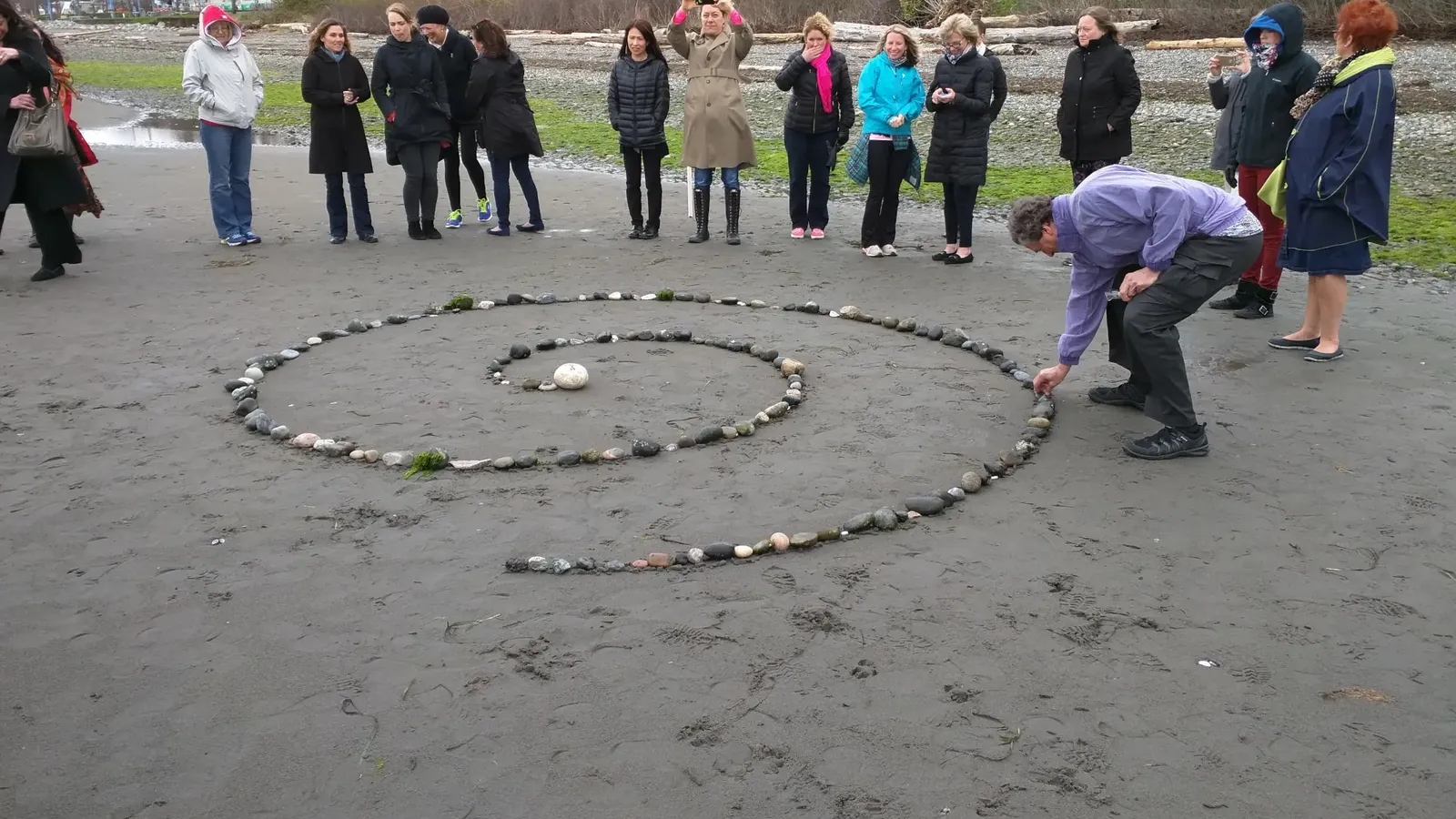
Boundaries are not barriers to expression; they are the structures within which trust and openness can emerge. A spiral labyrinth works because it has boundaries—the lines that mark the path—but within those boundaries, infinite variation is possible. The same is true in creating safe space for trauma-informed work. We offer structure and consistency, and within that container, people find their own way.
The Foundation: Multiple Sessions
One of the most important—and most overlooked—principles of trauma-informed community work is time. Single sessions or open drop-in gatherings, however well-intentioned, do not provide enough context for building belonging, trust, and safety. These are the very conditions required for meaningful engagement with difficult content. Without them, single sessions risk causing harm.
Trauma and vicarious trauma happen commonly in open sessions that lack sufficient structure and relational foundation. When people gather for the first time to discuss residential schools, genocide, displacement, or systemic violence—topics freighted with personal and collective pain—they do so without knowing one another, without established norms, without trust. In these conditions, someone may share something deeply vulnerable only to have another participant respond in a way that feels dismissive or harmful. Someone may become overwhelmed with no sense of whether the space can hold them. The facilitator, lacking knowledge of group dynamics and individual histories, may miss key signals of distress.
This happens regularly in museum and community settings where institutions convene people around difficult topics without adequate preparation or sustained engagement. The resulting harm can be significant: participants leave feeling exposed, unheard, or retraumatized. They may never return. They may tell others that the museum is not safe. And they would be right.
The alternative is to structure community engagement as a series of multiple sessions—ideally at least six—where the same group gathers repeatedly over time. This structure creates the conditions necessary for safe and meaningful work. It allows people to get to know one another. It builds trust incrementally. It establishes norms and rhythms. It provides time to repair ruptures when they occur. And it allows difficult conversations to emerge naturally once the foundation has been laid, rather than forcing them prematurely.
What Multiple Sessions Offer
A series of six or more sessions creates a developmental arc. Early sessions focus on building relationship and safety. Middle sessions deepen engagement and begin to address challenging content. Later sessions allow for integration, reflection, and planning for what comes next. This arc mirrors the way that meaningful human connection and healing actually unfold—slowly, with care, through repeated encounters.
In the first session, people arrive as strangers. The focus is not on the difficult topic but on beginning to know one another. Introductions happen, but not the formal, stilted kind where people state their credentials. Instead, people might be invited to share something simple and personal: a place that matters to them, an object they carry, a memory of kindness. The group might walk together—outside if weather permits—allowing conversation to emerge naturally in pairs or small clusters. Walking side by side, rather than sitting face to face, eases the intensity of eye contact and creates space for quieter people to participate. Or the group might share a meal together, the act of eating providing both ritual and pause. Food has always been a way humans create community and mark moments of gathering.
In the second and third sessions, the group begins to develop its own culture. People remember one another’s names and stories. Inside jokes emerge. Norms become clearer: how long people talk, how silence is held, what happens when disagreement arises. The facilitator continues to prioritize relationship-building but can begin to introduce creative or experiential activities that require collaboration. Making something together—drums, weavings, creative projects, garden beds—engages the hands and the body in ways that deepen connection. These activities are not distractions from the real work; they are the real work. They create shared experience and shared meaning. They allow people to contribute in ways that don’t require verbal articulateness. They produce tangible objects that carry the memory of being together.
By the fourth and fifth sessions, the group has developed enough trust and safety to begin engaging with difficult content. This is when conversations about residential schools, about cultural appropriation in exhibitions, about representation and voice can happen productively. People know the group well enough to take risks. They know who will listen with empathy and who might struggle. They know the facilitator can hold complexity and will intervene if things become unsafe. They have practiced being together during easier moments, so when difficulty arises, they have a foundation to return to. The container is strong enough to hold what emerges.
In the final session or two, the group reflects on the journey. What have we learned together? What remains unresolved? How will this work continue beyond these gatherings? There may be ritual closure: sharing gratitude, offering blessings, lighting candles, or returning to an activity from early sessions to mark how far the group has come. Participants should leave not only with whatever work was accomplished—consultation on an exhibition, development of interpretive text, identification of partnership opportunities—but also with the experience of having been part of something meaningful, something that honored their humanity and their contributions.
Sharing Trauma Stories
Even with trust established, the question of whether and how participants share their own trauma stories requires careful consideration. There is no formula. Group dynamics, the specific histories present, the skill of the facilitator, the evolution of the group over previous sessions—all of these factors interact in ways that cannot be fully predicted. This is the nature of complex systems. But some principles can guide the process.
Trauma stories should not be told in a circle. The standard configuration of group work—sitting together, facing one another, taking turns speaking—is too activating when the content is traumatic. One person’s raw account can trigger another’s, which triggers another’s, until the room fills with distress that no one can contain. Viral activation spreads faster than any facilitator can manage. The geometry of the circle, which works well for many purposes, becomes a liability when trauma is present. There is nowhere to look away. There is no shelter.
Instead, pair the telling with creative activity. Writing works particularly well. Participants might be invited to write about one moment—not the whole story, just one scene, one image, one fragment that holds something essential. The act of writing contains the experience. It provides distance. It allows revision, reconsideration, the shaping of raw material into form. Other modalities also work: visual art, collage, movement, song. What matters is that the trauma story passes through a creative process before being shared. This transformation is not avoidance. It is the beginning of meaning-making.
From that creative work, participants choose what to share. Perhaps a single paragraph read aloud. Perhaps one image held up without explanation. Perhaps a phrase or sentence that captures something true. The sharing is partial, bounded, chosen. It respects both the teller and the listeners. It acknowledges that not everything needs to be spoken in order to be witnessed.
Participants can ask for supports before sharing. They might want someone to sit beside them. They might want permission to stop at any point. They might want the group to remain silent afterward rather than respond. These requests should be honored. Different people need different things.
Above all, the telling of trauma stories must advance healing. This is the criterion that guides everything else. If sharing is simply the release of pain into a room, there is nowhere to go with it. The pain hangs in the air, unmetabolized, without direction. This helps no one. It may harm everyone.
For healing to occur, the story must have a direction—some sense of movement, of meaning, of what the experience has taught or where it is leading. Healing means the teller has begun to locate themselves in relation to their experience rather than being submerged by it—they have started to become the author of their story rather than only its subject. The story need not resolve or end well for this movement to occur.
Participants should not share until they have some sense of this direction. Facilitators can help people assess their readiness: Do you know what you want others to understand from this? Do you have a sense of where this experience sits in your life now? If the answer is no—if the trauma is still too raw, too overwhelming, too present—then sharing in a group is premature. It risks retraumatization for the teller and activation for everyone else. There will be time. The group will continue. The story can wait until it is ready to be told in a way that moves toward healing rather than merely reopening wounds.
Incorporating Creative and Experiential Work
Each session should incorporate some form of creative or experiential engagement, not only discussion. This serves multiple purposes. First, it regulates the nervous system. Talking about trauma can be activating; doing something with the hands helps ground and settle. Second, it creates entry points for those who think and process differently. Not everyone is comfortable with verbal discussion, but almost everyone can participate in making, walking, or tending. Third, it builds relationship through shared activity in ways that talking alone cannot. Working side by side on a garden bed or crafting a drum creates a different quality of connection than sitting across a table.
The specific activities should be chosen thoughtfully, in consultation with community partners when possible, and should connect meaningfully to the work at hand. If the group is consulting on an exhibition about land and displacement, perhaps sessions include walking the land around the museum, gathering stones or plants, creating small earthworks or cairns. If the focus is cultural expression, perhaps the group makes traditional crafts, cooks traditional foods, learns songs or stories. If the work addresses healing from historical trauma, perhaps sessions incorporate ceremony, drumming, or time in nature.
These activities need not be elaborate or require extensive resources. Even simple acts—brewing tea together at the start of each session, lighting a candle to mark the opening and closing, walking in silence for ten minutes—create ritual and rhythm. What matters is consistency and intentionality. The activities are not filler but integral to the process of building the relational foundation that makes difficult work possible.
Emergence
Something may emerge in the closing sessions: a sense that the story has moved. The story has moved—shifted rather than concluded, since trauma stories rarely conclude entirely. The experience that brought people here has not changed. What happened still happened. But its place in the larger narrative of a life may have altered. There is a before and after to the group itself now, a new chapter in which the wound was held differently than it had been held before.
Healing in practice means not the absence of pain but the presence of direction. The story goes somewhere. It is no longer only a record of harm but also a record of what followed: the risk of showing up, the discovery that others could witness without flinching, the slow accumulation of moments when the unbearable was borne together. These become part of the story too.
Sometimes wisdom emerges from the wound. This is not guaranteed, and it should never be demanded. The pressure to find meaning in suffering—to transform every tragedy into a lesson, every loss into growth—can become its own kind of violence. Some experiences simply hurt. They diminish. They take more than they give. To insist otherwise is to betray the people who carry them.
But sometimes, in the space created by care and sustained attention, something shifts. People discover capacities they did not know they had. They find that their experience, held within a community that took the time to build trust, has something to offer others walking similar paths. The wound becomes a place of knowing as well as damage. This cannot be forced—it can only be allowed when the conditions are right.
The ethics of care makes this possible. By attending to one another across multiple sessions—noticing who is struggling, offering presence without intrusion, holding back when holding back serves the group—participants create the conditions in which healing can occur. Not healing as cure. Not healing as the end of difficulty. Healing as the capacity to remain present to the struggle rather than being consumed by it. Healing as the ability to engage with life as it actually is, wounds included, rather than waiting for the pain to end before living can begin.
This is what participants carry forward: not only the work accomplished but the experience of having been accompanied. The story of their trauma now includes a chapter in which they were not alone. In which others cared enough to stay. In which the ethics of mutual obligation—I will attend to your wellbeing as the condition for expressing my own—created something that none of them could have created alone. This, too, becomes part of who they are.
Practical Strategies
Several practical strategies strengthen trauma-informed community collaboration structured across multiple sessions:
Commitment from the start. When inviting participants, be clear that this is a series, not a single session or drop-in opportunity. Ask people to commit to attending all sessions if possible. This commitment signals seriousness and helps the group cohere. Some people will be unable to commit to every session due to life circumstances; that’s understandable. But a stable core group that develops continuity is essential.
Consistent facilitation. The same facilitator (or facilitation team) should be present for all sessions. Changing facilitators between sessions disrupts trust and requires starting over with relationship-building. The facilitator becomes a consistent presence, a holder of the group’s story, someone who remembers what was said in session two and can reference it in session five.
Clear agreements. In the first session, establish ground rules together: confidentiality (with clarity about any limits), respect for different perspectives, the right to pass or step out, how conflict will be handled, expectations around attendance. These agreements can be revisited and revised as needed, but having them creates a shared container.
Accessibility support. Ensure translation, transportation assistance, child care, or other supports are available for all sessions, not just some. If someone cannot attend because they lack child care, the series fails for them.
Compensation. Pay participants for their time and expertise, not only for the final product but for their participation in the process. This might be honoraria, gift cards, or other forms of recognition. Time is valuable; expertise is valuable. Compensation demonstrates respect.
Space for ceremony and culture. If participants wish to open or close sessions with cultural practices, welcome this. Allow extra time so these practices don’t feel rushed. Work with cultural advisors or Elders to ensure practices are conducted appropriately.
Documentation with care. If sessions are recorded or notes taken, be transparent about this. Participants should know who will have access and how materials will be used. For some content, participants may prefer that certain stories or perspectives remain unrecorded—shared verbally in the moment but not documented. Honor these boundaries.
Follow-up between sessions. Check in with participants between gatherings, especially if someone seemed distressed or withdrew. Brief emails or calls—Just wanted to see how you’re doing after last session—maintain connection and demonstrate ongoing care.
Safe Group Facilitation
Community gatherings, particularly those structured across multiple sessions, require skilled facilitation. The facilitator’s role is complex: hold space without controlling it, invite participation without demanding it, notice patterns without judging them, intervene when needed without overstepping. The skills required are those explored in Supporting Colleagues and Core Principles: self-awareness, presence, empathy, congruence, boundaries.
The facilitator must be aware of their own activation, their own biases, their own discomfort with silence or conflict. They must be able to recognize when the container needs strengthening—when energy is scattered, when someone is overwhelmed, when conflict is emerging. They must know how to intervene in ways that support rather than control: It seems like we’re moving in several directions at once. Should we pause and see where we actually want to focus? or I’m noticing this conversation is landing heavily. Let’s take a breath together.
Facilitators should ideally receive training in trauma-informed group processes. Reading a manual cannot prepare someone to facilitate trauma-informed group processes. It requires practice, supervision, feedback, and ongoing learning. Museums developing this capacity should invest in training facilitators thoroughly and providing them with ongoing support through consultation and peer supervision.
Virtual and Hybrid Engagement
The preceding sections assume what is ideal: that community partners can gather in person, repeatedly, over time. This allows for the full expression of trauma-informed principles—embodied presence, shared meals, walking together, creative work with hands and materials, the subtle attunement that happens when humans occupy the same physical space. The body reads other bodies. The nervous system settles in the presence of settled others. Trust builds through the accumulation of small, unremarkable moments: someone remembering how you take your tea, the shared laugh after a stumble over words, the quiet that falls when something lands heavily.
Virtual engagement cannot replicate this. It would be dishonest to suggest otherwise. Video calls flatten the three-dimensional richness of human presence into a grid of faces. The technology itself creates a slight but persistent cognitive load—managing one’s own image, interpreting reduced nonverbal cues, navigating mute buttons and connectivity issues. For participants already carrying trauma, this additional burden matters.
Geography, however, is real. Advisory groups may include members spread across the country or beyond. Travel budgets are limited. Time constraints are significant. Climate considerations may discourage repeated flights. Accessibility needs may make in-person attendance impossible for some participants. To insist on in-person engagement as the only legitimate form may exclude the very communities whose voices are most needed.
The question, then, is not whether virtual engagement is as good as in-person—it is not—but rather: What is good enough, given the constraints? What principles can be preserved, even in diminished form? What additional care must be taken to compensate for what’s lost?
What Good Enough Requires
If meeting in person over multiple sessions is ideal, what might be considered good enough when resources or geography prevent this?
At minimum, at least one in-person gathering. If the series includes six sessions, perhaps the first and last can happen in person, with virtual meetings in between. The initial gathering establishes relationships, creates shared memory, allows people to learn each other’s presence in ways that virtual interaction cannot. The final gathering provides ritual closure, the opportunity to mark what was built together, the chance to say goodbye in embodied space. These bookends anchor the work.
Extended virtual sessions with embedded breaks. A two-hour video call is exhausting in ways that a two-hour in-person meeting is not. Plan for shorter active segments—perhaps forty-five minutes to an hour—punctuated by genuine breaks. Not two minutes to refill coffee, but fifteen to twenty minutes where cameras are off, where people step away from screens, where bodies move. Encourage participants to go outside if possible, even briefly.
Pre-session and post-session connection. What video calls lack in presence they can compensate for, partially, through increased frequency of lower-intensity contact. A brief phone call before a session—I wanted to check in ahead of tomorrow—establishes connection that the session itself can build upon. A follow-up email or text after a session—I’ve been thinking about what you shared. How are you feeling about it now?—extends the relational thread beyond the meeting’s boundaries.
Smaller subgroups. Large video calls make individual presence nearly invisible. Consider breaking into smaller groups—three or four people—for portions of each session. These breakout conversations allow for more intimate exchange, more sustained attention to any one person, more opportunity for quieter voices to emerge.
Consistent visual environment. Participants should be able to see one another clearly, with reasonable lighting and camera positioning. This is not about polish or professionalism but about reducing the cognitive work of interpreting faces that are shadowed, pixelated, or poorly framed. The facilitator might offer brief guidance at the outset: Can everyone see each other well? Let’s take a moment to adjust lighting or camera angle if needed.
Explicit attention to what’s missing. The facilitator should name, out loud, what virtual engagement makes harder. We’re missing the chance to share a meal together. We can’t walk side by side the way we might if we were in the same place. I want to acknowledge that this format asks more of everyone. This transparency validates what participants may already be feeling and creates permission to express fatigue or disconnection without shame.
Adapting Core Practices
Many of the practices described earlier can be adapted—imperfectly—for virtual settings.
Opening and closing rituals. Lighting a candle at the start and end of each session works just as well on camera. Participants might each have their own candle, creating a distributed but shared ritual. A moment of silence together, with cameras on but no expectation to speak, can settle the group even through screens.
Creative work. Though making things together loses its immediacy in virtual settings, participants can engage in parallel creative activities. Perhaps everyone receives a small kit of materials before the series begins—clay, paper, colored pencils, fabric scraps—and each session includes time for hands-on work while conversation continues. While we talk, feel free to work with the materials in front of you. This engages the body, provides an alternative channel for expression, and creates tangible objects that carry the memory of the work together.
Walking and movement. A group cannot walk together virtually, but individuals can. Consider structuring sessions so that part of the meeting happens while participants walk, using earbuds and phone cameras rather than sitting at desks. The change in environment and the movement of the body shifts the quality of attention and may surface different kinds of reflection.
Shared meals. Eating together while on video lacks the communion of a shared table, but it remains a meaningful practice. Perhaps one session each series includes a virtual meal—everyone brings their lunch or tea—with the explicit framing that this time is less about agenda and more about simply being together.
Facilitation in Virtual Spaces
Skilled facilitation matters even more when the medium is virtual. The facilitator must work harder to read the room—or rather, the grid of faces—because signals are muted and context is reduced. They must be more explicit in checking in: I’m noticing some quieter energy. Does anyone want to share what’s coming up? They must be more active in naming dynamics: We’ve heard a lot from a few voices. Let’s make sure there’s space for others who haven’t spoken yet.
The facilitator should also attend to their own presence. On video, facial expressions and vocal tone carry even more weight because other nonverbal channels are diminished. A face that is warm and open, a voice that is calm and unhurried, a manner that conveys genuine curiosity—these become essential. The facilitator’s regulation helps regulate the group.
Technical difficulties will happen. The facilitator’s response to these moments models how the group can hold disruption. It looks like we’ve lost Janice. Let’s pause for a moment and see if she can reconnect. Rather than treating technical glitches as failures to be minimized, they can become opportunities for patience and flexibility—qualities that trauma-informed practice develops.
Hybrid Formats
When some participants gather in person while others join virtually, new complexities arise. The in-person participants naturally develop stronger connection with one another; the virtual participants can feel like observers rather than full members of the group. Power dynamics that already exist may be amplified.
Ensure parity of presence. If possible, arrange the room so that virtual participants are visible on a large screen at eye level, as though they were sitting at the table. Their faces should be large enough to read. Sound should be clear in both directions—this may require dedicated microphones rather than relying on laptop audio. The goal is to minimize the sense that virtual participants are watching through a window rather than sitting in the room.
In-person participants should use individual devices. Even if several people are gathered in the same room, having each person on their own laptop or tablet—with their own camera and microphone—equalizes the visual experience for virtual participants. Instead of seeing a group clustered around a conference table, virtual participants see the same grid of faces that would appear in a fully virtual meeting.
Assign an advocate for virtual participants. Someone in the physical room should take explicit responsibility for ensuring that virtual voices are heard. This person watches for raised hands in the chat, notices when a virtual participant seems to want to speak, and interrupts the flow when necessary: I think Maya has something to add.
Name the asymmetry. The facilitator should acknowledge, directly, that the hybrid format creates different experiences. Those of us here in person have the advantage of being together. Those joining remotely are working harder to stay connected. Let’s all be mindful of that throughout our time together.
Written Communication
Between sessions, and often throughout ongoing partnership work, communication happens in writing—emails, messages, shared documents. Written communication lacks not only the embodied presence of face-to-face interaction but also the vocal tone and pacing of a phone call. Without these cues, messages can land more harshly than intended. A sentence that would feel warm if spoken can feel cold or transactional when read.
Lead with relationship. Begin emails with a sentence or two that acknowledges the person, not only the task. I hope this week has been gentle for you or I’ve been thinking about our conversation last session or simply It’s good to be in touch. These openings signal that the relationship matters, that the recipient is a person and not merely a recipient of information.
Slow down. Written communication invites rapid response, but speed is not always appropriate. If an email lands heavily—if it contains difficult news, or responds to something the recipient shared vulnerably—take time before replying. Let the message sit. Consider what the person might most need to hear. When you do reply, acknowledge the weight of what they’ve shared: Thank you for trusting me with this. I wanted to take time before responding.
Be explicit about tone. Without vocal cues, readers fill in the blanks with their own assumptions—often negatively. Consider adding brief phrases that convey warmth: I hope this doesn’t come across as pressure, but… or I want to be clear that this is just a thought, not an expectation. What might seem unnecessary in speech becomes essential in writing.
Offer multiple channels. Some topics are better discussed in real time. If a written exchange seems to be generating confusion or tension, offer to move to a call: I’m wondering if this might be easier to talk through. Would you be open to a brief call this week?
Honor response time. Community partners who carry ongoing trauma may not have the capacity to respond quickly. Avoid follow-up messages that imply impatience. If a response is needed by a particular date, state this clearly and early, with explanation: We’d appreciate hearing from you by Friday if possible, so we can finalize the draft before the weekend. But if that doesn’t work, please let me know—we can adjust.
When Virtual Becomes Primary
For some ongoing partnerships—particularly those that span great distances or involve participants with limited capacity for travel—virtual engagement may become the primary mode of connection. In these cases, the orientation shifts. Rather than treating virtual interaction as a temporary compromise until in-person meetings can resume, the goal becomes making virtual engagement as rich and sustainable as possible.
This requires ongoing attention. Check in periodically about how the format is working: We’ve been meeting this way for several months now. How is it landing? What would make these sessions more supportive? Be willing to adjust based on feedback. Perhaps sessions need to be shorter, or less frequent, or structured differently.
Recognize that participant energy for virtual engagement will ebb and flow. After many months of video calls, fatigue accumulates. Consider occasionally shifting formats—an asynchronous activity where participants contribute on their own time, a series of one-on-one phone calls instead of a group meeting, a pause in meetings to allow for rest.
And continue to seek opportunities for in-person connection whenever they arise. Perhaps a conference brings several participants to the same city. Perhaps a funding opportunity allows for a gathering. These moments, however infrequent, replenish the relational reserves that sustain the work through the longer stretches of virtual engagement.
A Note of Honesty
Virtual engagement is harder. It is more tiring for facilitators and participants alike. It removes many of the embodied supports—physical presence, shared space, movement together—that help regulate the nervous system when engaging with difficult content. For groups working with ongoing trauma, this matters.
There is no formula that makes virtual engagement equivalent to in-person. What can be offered is intention, adaptability, and care. The same principles apply: build trust slowly, honor participant autonomy, create containers strong enough to hold difficulty, follow up when someone seems to be struggling, repair ruptures when they occur. These things can happen across distance. They simply require more deliberate effort.
The creative engagement approach holds here too. We are still carrying light through darkness, still offering companionship, still walking together toward something meaningful. The path is different—pixelated, fragmented, occasionally interrupted by technology failing—but the orientation remains the same: You do not walk alone. We are here together, carrying our lights, finding our way.
Preparing Participants in Advance
Even with multiple sessions, preparation remains important. Before the first gathering, community partners should know: What is the purpose of these sessions? What will we be working toward together? How many sessions are planned? What kinds of activities might be involved? How will contributions be used? What happens after the series concludes?
This information should be provided in accessible formats—written materials for those who want them, phone calls for those who prefer verbal explanation, meetings with community leaders who can communicate with their members. The goal is informed consent: people should choose to participate knowing what they’re agreeing to.
Preparation also includes being honest about constraints. If the museum cannot guarantee that community input will determine final decisions, say so. If budget limits certain possibilities, acknowledge this. If timelines are fixed due to external factors, explain why. Honesty about limits builds trust more effectively than overpromising and underdelivering.
The Value of Follow-Up
When a series of sessions concludes, follow-up becomes even more important. Participants have invested significant time and emotional energy. They deserve to know what happened with their contributions. Did their input shape the exhibition? Were their concerns addressed? If recommendations couldn’t be implemented, why not?
Follow-up might include: a report summarizing the series and its outcomes, individual thank-you notes to participants, invitation to a preview of the exhibition or project they contributed to, ongoing consultation as implementation progresses, or a final gathering several months later to reflect on impact.
Follow-up also creates opportunity to address any harm that occurred during the series. Despite best intentions, things can go wrong. Someone might have felt unheard. A conflict might have left residue. The facilitator or museum representative can reach out: I’ve been thinking about what happened in session four. I wanted to check in with you about it. These conversations, difficult as they are, demonstrate accountability and commitment to relationship.
Shared Authority and Power Dynamics
The multiple-session structure creates conditions for more genuine shared authority. When people gather only once, power imbalances persist: the museum sets the agenda, controls the timeline, extracts what it needs, and leaves. But across six sessions, different dynamics can emerge. Participants can suggest topics for discussion. They can propose activities. They can challenge assumptions and push back on framings. The group develops its own culture, one that the museum doesn’t fully control.
This can be uncomfortable for institutions accustomed to being in charge. But it is necessary for trauma-informed practice. True collaboration requires ceding some control, trusting the group’s process, allowing outcomes to emerge rather than being predetermined. The facilitator’s role shifts from leading to accompanying, from directing to holding space for whatever the group needs to work through together.
Transparency about power remains important. The museum retains certain authorities—budget decisions, final exhibition choices, timelines. These should be named honestly. But within those constraints, much can be negotiated and shared. Perhaps participants can help decide how honoraria are distributed. Perhaps they can suggest which sessions include ceremony. Perhaps they influence not only content but also process: how meetings run, what activities are chosen, how decisions are made.
Considerations for Historically Marginalized Groups
Research consistently shows that members of historically marginalized groups—including Indigenous peoples, racialized communities, LGBTQ2S+ individuals, people with disabilities, and others—experience higher rates of adverse childhood experiences and ongoing exposure to systemic harms. These disparities are not individual characteristics but rather the effects of systems: colonization, discrimination, economic exclusion, and structural violence that create conditions where harm is more likely to occur. The data on ACEs, for example, shows elevated rates among female youth and LGBTQ2S+ individuals—not because of anything inherent to these groups but because of how society has treated them.
This acknowledgment is important. It shapes how we understand the landscape of trauma and informs the care with which we design spaces, train staff, and engage communities. Visitors arriving at exhibitions on residential schools, systemic racism, or displacement may well carry not only intellectual understanding of these histories but lived experience of their ongoing effects. Staff from marginalized communities may encounter particular resonance when working with difficult content. The potential for activation is real and should inform our practices.
This acknowledgment, however, carries its own risk: the assumption that every person from a marginalized group has been harmed by that marginality. Some individuals experience this assumption as its own form of harm—a subtle message that they are seen primarily through the lens of victimhood, that their identity is reduced to a catalogue of presumed suffering. A visitor who happens to be Indigenous should not be presumed to need particular support simply because of their identity. A staff member who is LGBTQ2S+ may or may not carry trauma related to that aspect of who they are.
Human experience is endlessly diverse. Two people who share group membership may have had radically different lives, different families, different communities, different protective factors and risk factors. One person may carry deep wounds from discrimination; another may not. One person may find discussions of historical trauma activating; another may find them intellectually engaging but emotionally neutral. We cannot know, from the outside, which is which.
Trauma-informed practice therefore requires a particular discipline: holding statistical realities in one hand while respecting individual diversity in the other. We design spaces and train staff with awareness that marginalized visitors and colleagues may have particular needs—but we do not presume to know what those needs are until we are told. We create conditions for disclosure without requiring it. We offer support without assuming it is needed. We ask What would be helpful for you right now? rather than projecting our assumptions about what someone’s experience must have been.
This approach honors the core principles of trauma-informed care: agency, empowerment, and choice. The person before us is the expert on their own life. Our role is to create the conditions where they can share what they wish to share, ask for what they need, and navigate the space in ways that work for them. The fact that someone belongs to a particular group may inform our awareness but should not determine our response. Each person deserves to be met as an individual—not as a representative of a category.
In practice, this means several things. Staff should be trained to offer support without making assumptions. Signage and advisories should be available to all visitors without singling out particular groups. Reflection spaces and staff assistance should be equally accessible whether or not someone appears to belong to a community connected to the content. And when engaging with community partners, we should listen first—allowing people to share their unique experiences, perspectives, and needs rather than assuming we already know based on what we think their group membership or identity entails.
The balance is delicate but essential. Acknowledgment of systemic harm is not the same as presumption of individual harm. Awareness of patterns is not the same as stereotyping. Being prepared without being presumptuous, sensitive without being patronizing, honoring both the realities of oppression and the infinite variety of how people live within and beyond those realities—this is what the work requires.
Scenarios
Indigenous consultation on treaty exhibition, six-session series. Sessions one and two focus on relationship-building through shared meals and storytelling. Session three includes a guided walk on treaty territory with an Elder, gathering objects and stories. Session four begins engaging with exhibition content—what’s included, what’s missing. Session five addresses co-creating interpretive text and image selection. Session six includes ceremony to close the series and a commitment to ongoing consultation as the exhibition develops. Throughout, participants are compensated, translation is provided, and a cultural worker is present to support anyone who needs it. Six months later, participants are invited to a preview before public opening.
Refugee group contributing testimonies, eight-session series. Because of the intense nature of testimony and the particular vulnerabilities of this group, eight sessions are planned instead of six. Early sessions include creative activities—making projects together, tending a small garden plot near the museum—and shared meals featuring foods from participants’ countries. Middle sessions gradually introduce the topic of testimony: What stories do we want to tell? How do we want them told? Who is the audience? Later sessions address recording testimonies, but only after substantial trust has been built. Participants can choose how their stories are used, what remains private. A counsellor is present at all sessions. Follow-up includes continued garden tending together and a reunion six months later to see how the exhibition unfolds.
Survivors co-designing interpretive text, six-session series. Session one includes introductions and agreement-setting. Session two addresses making drums together—a multi-hour process that requires patience and creates shared experience. Sessions three and four engage with draft text, with participants offering feedback and alternative framings. Session five addresses resolving disagreements about how certain narratives should be presented—the facilitator holds space for multiple truths. Session six includes reflection on the process and planning for how participants might be involved in public programs when the exhibition opens. Throughout, the same facilitation team is present, creating continuity and trust.
Managing Contributions
When community partnerships involve the transfer of material—objects for loan or donation, personal stories for exhibition, financial contributions—an additional layer of care becomes necessary. These exchanges are often deeply meaningful to contributors. A survivor lending their artifact, a family donating a loved one’s belongings, a community member sharing a story of harm and healing: these acts require significant trust. Managing expectations around such contributions is both a practical necessity and an ethical imperative.
Setting Expectations Early
Honesty about limits builds trust more effectively than overpromising and underdelivering. Before accepting a donation or loan, clarity is essential: How will this object or story be used? Who will make curatorial decisions? What control, if any, will the contributor have over interpretation or display?
The museum cannot guarantee that donors will influence how their contributions are used—and this should be stated plainly, without apology. A conversation might include language such as: We are honored by your willingness to share this with us. I want to be transparent that once we accept this contribution, our curatorial and exhibition teams will make decisions about how it is used. We cannot promise that your wishes about display or interpretation will determine the final outcome. We will listen to your perspective, and we will treat your contribution with care—but the decisions will ultimately rest with the museum.
This clarity may feel uncomfortable, particularly when the contribution is deeply personal or financially significant. But discomfort in the moment is preferable to betrayal later. A donor who understands the boundaries from the beginning is far more likely to feel respected than one who discovers those boundaries only when their expectations are not met.
For personal objects—those carrying family memory, survivor testimony, or intergenerational significance—the conversation requires particular delicacy. These are not merely artifacts; they are vessels of story, loss, resilience. Staff should acknowledge this directly: I can see how much this means to you. That makes it even more important that we are honest about how we work. We want to honor your contribution, and we also want you to make this decision with full information about what we can and cannot promise.
Financial Contributions and Influence
Similar principles apply to financial donations. Large contributions sometimes arrive with explicit or implicit expectations of influence—over exhibition content, programming decisions, or institutional direction. A trauma-informed approach requires clarity: donors do not purchase curatorial control.
This does not mean dismissing donors’ perspectives. Listening to their hopes for the contribution, understanding what it means to them, acknowledging their generosity: all of this is appropriate and respectful. What is not appropriate is allowing financial contributions to reshape institutional integrity or compromise the museum’s relationship with affected communities. The distinction is between honoring a donor’s investment and being captured by it.
Language for these conversations might include: Your generosity makes this work possible, and we are deeply grateful. I want to be clear that our curatorial and programming decisions are guided by our institutional mission and by our relationships with the communities whose stories we tell. We welcome your input and perspective, and we will keep you informed about how your contribution supports our work—but we cannot promise that your preferences will determine exhibition content or direction.
When Contributors Want to Withdraw
Despite careful preparation, circumstances change. A donor may later regret sharing a story. A family may want an object returned. A community member may feel that the museum has not honored their trust. Withdrawal requests—whether of material, stories, or ongoing participation—require a response that affirms agency and preserves relationship.
The principle here is simple: agency is not conditional. If empowerment is a core value of trauma-informed practice, it cannot be revoked when someone exercises it in ways we find inconvenient. A contributor who wishes to withdraw has every right to do so. Our response should honor that right without hesitation, qualification, or guilt.
Language for these moments might include: Thank you for letting us know. Your story [or object, or contribution] was shared with us freely, and you have every right to ask that we no longer use it. We will make that happen. I’m sorry if something in our process didn’t feel right, and I’d welcome the chance to hear more about your experience if you’re willing to share—but that’s entirely up to you.
For physical objects, the process may involve logistical complexity: returning loans, coordinating pickup, updating exhibition materials. None of this complexity should become a barrier to honoring the request. Staff should be prepared to navigate logistics without burdening the contributor with administrative friction.
For stories and testimony, withdrawal may mean removing content from exhibitions, educational materials, or archives. This can be disruptive—but the disruption is the museum’s responsibility to absorb, not the contributor’s. The person who shared their story should not be made to feel that their withdrawal is causing harm or inconvenience.
Parting Ways Respectfully
Not all withdrawals signal rupture. Sometimes people simply need their belongings returned, or feel the time has come to reclaim what they shared. In these cases, the parting can be warm: We were honored to hold this for a time. Thank you for trusting us with it.
In other cases, withdrawal may follow disappointment or harm. The contributor may feel betrayed, unheard, or misrepresented. These situations are harder—but they are not failures of the contributor. They are opportunities for the museum to practice accountability.
Even when the relationship has frayed, the museum can express care: I understand this didn’t unfold the way you hoped. That matters to us. We want to return what belongs to you without delay, and we want to thank you for what you shared with us, even though this ending is painful. The goal is not to repair everything in the moment but to leave the door open, to preserve the possibility of relationship, and—most importantly—to avoid compounding harm.
Documentation and Agreements
Clear written agreements at the outset help manage expectations and provide reference if questions arise later. These documents should include: how the contribution will be used; who makes decisions about interpretation and display; whether the contributor retains any approval rights (and if so, what those rights include); the process for requesting withdrawal or return; and any relevant timelines.
Such agreements should be written in plain language, reviewed with contributors in conversation (not simply sent for signature), and revisited if circumstances change. The agreement is a tool for clarity, not a shield against accountability. If a contributor feels harmed despite having signed an agreement, the document does not absolve the museum of responsibility to respond with care.
Toward Sustainable Partnerships
Trauma-informed collaboration is an ongoing process requiring preparation, sustained engagement across multiple sessions, creative and experiential work alongside discussion, and thoughtful follow-up. Constraints are real—budgets, timelines, institutional requirements—but structuring engagement as a series rather than single encounters fundamentally shifts what becomes possible.
This means recognizing that community partnerships are not transactions but relationships. Relationships require time—time to build trust, time to repair when things go wrong, time to develop the safety necessary for engaging with difficult content. They cannot be rushed or compressed into single encounters without causing harm.
By creating dialogue across multiple sessions, incorporating creative and experiential work, preparing thoughtfully, facilitating with skill and humility, compensating fairly, and following up with care, the museum can ensure partnerships are genuine, dignified, and sustainable. The museum becomes a place where communities actively shape the narratives that affect them. And perhaps most importantly, it becomes a place where the process itself—the walking together, the making together, the sitting with difficulty together—honors the humanity of everyone involved.
To light a candle is to cast a shadow.
This page is part of the Trauma-Informed Museum Practices Guide