The Wreckage on the Shore
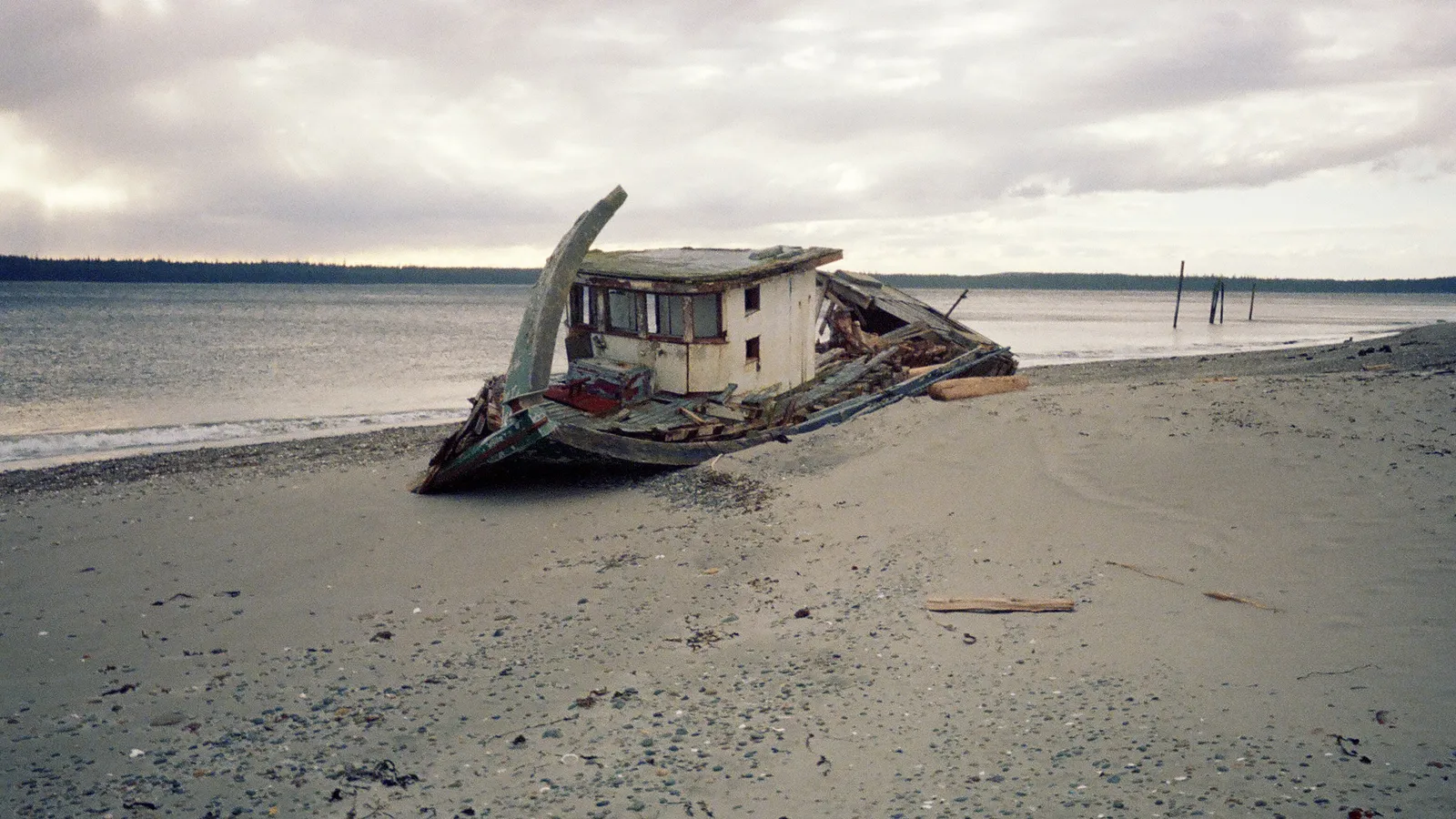
The afternoon light is fading. Across the strait, a green landscape is awash with a shimmer of twilight and distance. Behind me, the sun descends toward the mountains. Beyond them is the wide sea. The light is soft, and warm for spring at this latitude—high on the shoulder of the world, where even in deep summer the days could not be called hot. The skeleton of a wrecked fishing boat lies on the beach, its ribs reaching from the sand and its battered wheelhouse slanting off the deck. A mass of rusted iron—the engine, perhaps, or a tangle of old anchor chain—stains the pale sand at the boat’s stern. Most of the lapstrake hull is gone, save for a few bow planks half hidden in the muck. Rust streaks from rotting deck hardware run through what remains of the once white wood. And yet, at one time this would have been a nimble craft, capable of chopping through breakers and cresting the larger swells of this northern sea. Probably the boat was used by several generations of halibut fishermen before finally breaking up here on this irascible shore. The wreck possesses an eerie beauty, a defiance almost, in the face of this windswept and lovely and lonely place.
This wrecked boat—battered but still present, broken but not disappeared, defiant in its refusal to be completely erased—is the metaphor for what I call addictions of defiance. These are patterns organized around anger, powered by rage, maintained through substances and behaviors that provide temporary access to power. These addictions, more than any others, are rooted in experiences of having power taken away, of being controlled or violated during the developmental period when a child is learning whether their will matters, whether their refusal is respected, whether they can have power without losing love.
If you are reading this as a parent or loved one, you may recognize someone you care about in these words. The person who fights everything, who cannot accept any authority, whose anger seems always just beneath the surface. The one who drinks and becomes powerful, who uses alcohol to access the rage that can’t be expressed sober. The one whose defiance has cost them jobs, relationships, freedom—but who cannot stop fighting even when the fight destroys them.
If you are reading this as someone who recognizes yourself—who knows what it feels like to have your power stolen, to be overpowered until defiance became your only identity, to find in alcohol the courage to express what cannot be said sober—then this chapter is for you too. To help you understand where the rage comes from, and what might make peace possible without requiring surrender.
Why Understanding This Matters
When someone you love fights everything—using alcohol to fuel anger, defying every authority, refusing to submit even when submission would make their life easier—the natural response is frustration. Why can’t they just go along? Why does everything have to be a battle?
The pattern of defiant substance use often has roots extending back to toddlerhood, when a developing nervous system learns whether asserting will is safe, whether refusal will be respected, whether having power costs you love and connection. When those early experiences teach that power will be taken away, a profound vulnerability forms. The nervous system learns to fight back, to refuse submission, to access power through any means available.
What looks like pointless defiance is often a nervous system doing exactly what it learned to do to survive.
The Pathway from Early Experience to Addiction
Between two and four years old, children discover will. They learn whether their “no” matters, whether asserting power costs them love. When this stage proceeds well, power and connection coexist. When it’s disrupted—through total control, harsh punishment, humiliation—the nervous system faces an impossible dilemma: the drive to have will is biological, unavoidable, but exercising it brings punishment or abandonment.
The solution is organized defiance. The child learns to fight for every scrap of agency, to refuse submission even when resistance brings pain. Anger becomes the primary response to any threat of control. Over time, this extends into chronic rage that colors all experience—constant irritation, quick fury, the sense that others are always trying to dominate.
Then the person discovers alcohol. It doesn’t create the anger; it unleashes what’s already there. It provides temporary access to power, disinhibits rage, gives courage to fight back. The substance validates the pattern, confirming that the world is full of people trying to control you. And any attempt to impose limits—including treatment—is experienced as the very control that created the pattern in the first place.
These harms are more common than we might expect. Consider spanking, for example—a normal childhood experience. Spanking in childhood is associated with greater risks in adulthood for suicide attempts, moderate to heavy drinking, lower levels of mental health, higher levels of aggression, antisocial behavior, and an increased likelihood of abusing one’s own child or spouse. And studies of spanking find no positive outcomes: no greater self-control, or personal discipline, or any of the other goals parents typically indicate as being the “lessons” of spanking.
There is no meaningful distinction between discipline and harm when it comes to spanking and similar forms of physical punishment. These findings hold across cultures and the neurological mechanisms (threat-system sensitization) are well understood. Even “mild” physical discipline creates lasting vulnerability.
And yet, many people who experienced spanking and other forms of physical punishment will say (and believe) that they “turned out fine.” This blind spot often prevents people from recognizing and addressing the harms they carry—harms that can fuel mental health struggles and addictions. And, often, they unintentionally pass those harms along to those they most love: spouses, and, especially, kids.
Is it any wonder that one in eight Canadian adults shows symptoms of alcohol dependence—and that alcohol remains one of the leading preventable causes of death in this country?
The Learning of Defiance
I’ve watched this pattern take hold across many variations. Sometimes it’s the parent who cannot tolerate any assertion of will, who requires complete compliance, who sees the child’s refusal as intolerable disobedience. Every expression of preference is met with force. The child learns that their power threatens others, that maintaining any agency requires constant battle.
Sometimes it’s harsh punishment—physical discipline, shaming, humiliation for normal assertions of will. The child refuses and is spanked, asserts a preference and is told they’re bad, selfish, ungrateful. Constant internal rage develops because the will cannot be eliminated, only suppressed.
Sometimes every interaction becomes a power struggle, the caregiver needing to “win” every encounter. The child’s emerging will is experienced as a challenge that must be defeated. They learn that all relationship is war, and backing down means total defeat.
Sometimes it’s inconsistent limits—boundaries that shift unpredictably based on the parent’s mood. The same assertion is tolerated one day, punished harshly the next. There’s no way to learn appropriate exercise of power when the rules keep changing. Chronic anger becomes the only reliable response.
These variations create the same vulnerability: a nervous system organized around fighting back, a conviction that power must be seized and defended, a stance of perpetual opposition.
Collective Trauma: When Entire Communities Lose Power
I’ve spent time teaching in Indigenous communities in the far north, working with people healing from what colonization has done to entire cultures. I have worked in many situations like this. I know what happens when a culture is almost destroyed by childhood trauma, disease, and spiritual devastation: people drink. Alcohol is almost always the substance of choice for trauma survivors dealing with powerlessness and rage. It promises power, and pride, and redemption delivered by way of anger.
When an entire culture is systematically stripped of power—when children are torn from families, language is forbidden, traditional governance is destroyed, land is stolen, spiritual practices are criminalized—the disruption happens at a community level across generations. Almost every child growing up in this context receives the developmental message: we have no legitimate power, our will doesn’t matter, resistance brings destruction.
But the human spirit does not accept powerlessness quietly. When power cannot be expressed legitimately, it emerges through defiance, through alcohol-fueled rage, through self-destructive assertion that says: you cannot completely control me, even if the only power I have left is the power to destroy myself.
This is collective developmental trauma—entire communities organized around anger as one of the only acceptable emotions, using alcohol to access power that has been systematically denied. This explains why traditional addiction treatment often fails in these contexts. Treatment that demands submission, that requires accepting powerlessness, that positions helpers as authorities who know better, replicates the exact dynamic that created the addiction in the first place.
For Parents: What This Means About You
If you’re a parent reading this, you may recognize yourself in these descriptions. Perhaps you couldn’t tolerate your child’s defiance, needed to win every battle, responded to their refusal with force or humiliation. The developmental perspective is not an accusation. If you couldn’t tolerate their assertion of will, you probably had reasons—your own childhood where defiance was forbidden, circumstances that demanded compliance, trauma that made their power unbearable to witness.
The impact on the child is real regardless of the cause. Your best might not have been enough for what their developing sense of power needed during that window. This is painful to hold, but not being enough doesn’t mean you failed as a parent. It means you were human, limited, doing what you could.
What created the vulnerability can guide what might help now. The person struggling with alcohol and anger isn’t just stubborn—they’re responding from a nervous system organized by early experience. These patterns often run through generations. Awareness of this can help break the cycle.
If You Recognize Yourself
If you recognize your own pattern here—the rage beneath the surface, the drinking that unleashes it, the defiance that costs you everything but that you cannot abandon—this pattern makes sense. It developed for good reasons. Your nervous system learned early that power would be taken if you didn’t fight for it. The defiance protected you when submission would have meant erasure.
The alcohol isn’t just about getting drunk. It provides a sense of power you can’t access sober, disinhibits the anger you’ve learned to suppress, gives you courage to fight back. A nervous system finding a way to express what cannot otherwise be expressed.
You’re not trapped by this pattern. The same nervous system that learned to fight can learn that power doesn’t always require battle—slowly, through experiences where asserting yourself doesn’t cost you connection. It happens through accumulated experiences that teach your system something new: that refusal can be respected without war, that power can be constructive, that you don’t have to choose between agency and relationships.
Recovery doesn’t mean eliminating your capacity for anger or your refusal to be controlled. Righteous anger at injustice, fierce protection of boundaries, refusal to submit to genuine oppression—these are genuine strengths. The question is whether you can choose when to fight rather than fighting everything.
What Alcohol Provides (And Why It’s Hard to Give Up)
For someone whose sober state feels powerless, alcohol creates the experience of being powerful. It gives permission to express rage that can’t be expressed sober, provides courage to fight back, allows refusal to finally be spoken. The substance use itself becomes an act of defiance—you can’t stop me from drinking becomes the proof that nobody can control you.
Each time alcohol provides this sense of agency, it confirms the original learning: sober means powerless, you need the substance to have a will. You can’t simply remove alcohol without addressing what it provides. If you take away someone’s only way to feel powerful, you leave them worse off than before.
Why We Resist What Would Help
People with defiance patterns resist help precisely because help comes from authority, and authority is the enemy. Traditional treatment—mandated attendance, required compliance, authority figures who claim to know what’s best, demands for submission (“admit you’re powerless”)—is experienced as the exact dominating control that activated the pattern in the first place.
Every requirement triggers defiance. Every authority figure becomes another person trying to break their will. Every rule becomes something to defy.
Arguments don’t work. You cannot argue someone out of a fight response. The system responds to accumulated experience, to repeated encounters that contradict its predictions about power. Recovery requires invitation, collaboration, acknowledgment that their will is legitimate.
What looks like defiance is often the system doing exactly what it was designed to do: refuse to surrender.
The Polar Bear: Archetype of Fierce Healing
While waiting for a small plane to return me from the north, I found myself thinking about polar bears. The polar bear is reputed to be the most dangerous of all land mammals. An adult male is a thousand pounds or more of claws, sharp teeth, colossal strength and frightening speed. Each paw is a foot wide, with claws as long as my fingers.
And yet, while polar bears have been known to attack people, in most cases the bear was either provoked or starving. Many bears have been shooed away, without incident, from homes and stores in the Far North. A woman once chased a bear from her porch by striking it with a broom.
But the tale that stays with me involves a man who was alone on the ice and was chased by a polar bear. The bear came after him slowly, taking its time. The man fled to exhaustion and eventual collapse on the frozen terrain. And to a final, hopeless turning toward this beast who had pursued him.
The man crouched on the ice. The bear approached, head down. There was a moment of stillness, of expectation. Then the bear came forward, head extended, mouth open, rows of teeth exposed. The man closed his eyes or held his hands before his face.
The bear licked one of the man’s hands, and did no more, and wandered off again into the North.
So gentle, that white bear, and so fierce. Black skin beneath shimmering translucent fur. A fusion of shadow and light.
The man who stops running, who turns toward the bear rather than fleeing, survives not through submission but through presence to the power pursuing him. The bear that could kill with one swipe instead offers gentleness—this is the transformation possible when power is acknowledged rather than denied.
What Actually Heals: Being Seen, Not Controlled
Research on recovery from addiction reveals something that traditional treatment often misses: the mechanism of change is not compliance with a program. What heals is belonging. The actual predictive factors for sustained recovery are social support, recovery-oriented networks, and purposeful contribution to others.
For people with defiance patterns, this is particularly important. Their addiction formed in response to having power stolen, to being controlled. As I mentioned above, recovery through more control—mandated treatment, required compliance, demands for submission—often fails because it replicates the original trauma. What works is the opposite: experiences of being welcomed without having to submit, being valued without having to comply, having power acknowledged and respected.
The defiant person doesn’t need another authority telling them what to do. They need a community where their power matters, where their refusal is respected, where they can contribute something only they can offer. Genuine participation where their presence and their will make a difference.
What Might Actually Help
Given everything we’ve explored about the defiance pattern, what can families and loved ones actually do? And what can people caught in the pattern do for themselves?
For Families
You’re seeing the fight response, not just stubbornness. Their nervous system is in a protective mode learned long ago. This reframing won’t eliminate your frustration, but it might help you respond with patience rather than engaging another power struggle.
Every battle you “win” confirms their worldview that relationship means someone has to lose. Offer choices rather than demands, frame requests as invitations, let them have power in the interaction.
Acknowledge legitimate anger. When the rage is about real injustice—and often it is—don’t minimize it. “What happened to you was wrong. Your anger makes sense.” Honor the feeling underneath while distinguishing it from destructive action. The anger is often legitimate; the destruction is something else.
Find opportunities for genuine power. Can they lead something? Contribute something only they can offer? Recovery happens when people discover their agency is real—through contribution, not compliance.
Support without controlling. You want them to stop drinking, stop fighting, stop destroying their lives. But every attempt to control activates their defiance. The work is being present, offering support, acknowledging their power—and letting them make their own choices.
Take care of yourself. Living with someone organized around defiance is exhausting. You cannot be a non-controlling presence if you’re depleted and desperate.
For People Caught in the Pattern
Your anger is often legitimate—response to real violation, real injustice. The pattern is that anger has become your only response, and alcohol your only access to expressing it.
If you find yourself fighting treatment, defying therapists, refusing programs—understand why. Help feels like control, and control is what hurt you. The resistance is protection. But the protection that saved you may be imprisoning you now.
Find communities, not programs. What heals is belonging, not compliance. Look for communities where your power is welcomed—where you can contribute, where your presence matters, where your boundaries are respected.
Choose physical activities that explore yielding, not more fighting. Combat sports, heavy weightlifting, high-intensity competition may simply channel aggression into more acceptable forms without transforming it. What might actually help is exploring strength through flexibility—tai chi, gardening, yoga, gentle partner work like dance— practices where power comes from yielding rather than forcing. The goal is discovering that power has many forms.
Practice noticing moments when you expect a battle and one doesn’t come, when your refusal is respected without escalation. Build evidence that power doesn’t always require war.
Find constructive outlets for legitimate rage. If your anger is about real injustice—and often it is—can it be channeled toward fighting that injustice in ways that create rather than destroy? Political advocacy, community organizing, artistic expression—any form where rage becomes fuel for change.
Consider that recovery is not surrender. You don’t have to accept powerlessness or submit. Recovery can mean discovering other forms of power, other ways of asserting will that don’t require alcohol or destruction.
The Two Tasks of Recovery
Recovery requires discovering that power can be reclaimed without alcohol, that boundaries can be respected without war, that will and connection can coexist. This learning requires accumulated experiences where asserting power doesn’t cost everything.
The second task is transforming rage from destructive to constructive expression. The anger is often legitimate. The work is helping it find expression that creates rather than destroys, that fights injustice rather than fighting everything.
Sometimes I notice the moment when this shifts. A person who has been fighting everything suddenly discriminates—this battle matters, that one doesn’t. Someone who could only say “no” discovers they can also say “yes.” Someone who experienced all authority as oppressive discovers one relationship where power is mutual.
When the Pattern Doesn’t Change
And for some people, the pattern doesn’t change. They try these approaches—find communities that welcome their power, explore physical practices that don’t reinforce fighting, work with helpers who don’t try to control them—and the defiance persists. The anger remains volcanic. The alcohol remains the only way they can feel powerful.
If you are one of these people, or if you love someone who is: some systems are organized at such depth that transformation requires more time, more resources, or more accumulated experiences of legitimate power than one lifetime can provide. Some people will manage the pattern rather than transform it—learning to live with the anger, finding harm-reduction approaches to alcohol, accepting that this is the configuration their system takes.
For some, medication-assisted treatment becomes a long-term component of stability rather than a temporary bridge. Medications can reduce the pull toward alcohol without requiring surrender. The goal is a life where connection and meaning become possible.
The Child Walking Away
I think of a vision that came to me during a workshop in the north—an image of a child walking away from her community. She walks down a long road in the early morning. She’s running away, not in panic but with deliberation. She’s claiming her power the only way she knows how: through departure, through defiance of the community’s expectations.
This child represents everyone who has had power stolen, everyone who must fight to maintain any agency, everyone who has learned that defiance is survival. She walks away because staying means submission. But she’s also walking toward something—toward a life where her will might matter, where her power might be legitimate, where she doesn’t have to choose between having agency and having love.
The healing of every community depends upon this child. Not on her staying or leaving, but on her discovering that she has power, that agency and connection can coexist. Whether she comes back or keeps walking, whether she finds her way through defiance or through something else, her journey is the journey every person with defiance patterns must make: from reactive defiance toward claimed power, from fighting everything toward choosing battles, from anger that destroys toward anger that creates.
The wrecked boat on the shore, defiant in its refusal to completely disappear, reminds us: even when battered, even when broken, even when facing attempts at erasure, the human spirit persists. Power cannot be finally stolen. Will cannot be ultimately denied. And healing—fierce, defiant, inevitable healing—goes on.
For Further Reflection
If You’re a Parent or Loved One
- What was your loved one’s early experience of will and power? How did caregivers respond to their refusal?
- What was your own relationship to power when raising them? Understanding helps you see the pattern clearly.
- Can you acknowledge their legitimate anger without accepting destructive behavior?
- Where might they find genuine power—opportunities to lead, contribute, matter?
- Can you offer support without controlling, let them make choices while staying in relationship?
If You Recognize the Pattern in Yourself
- When did the fight response begin? Can you trace it to early experiences of having your power taken away?
- What does alcohol provide that sobriety cannot? Understanding the function helps find alternatives.
- Where have your boundaries been respected without a battle? Finding one community where your power is welcomed may be the most important step.
- What would recovery look like if it didn’t require surrender?
This page is part of the Guide for Parents