The City’s Invisible Line
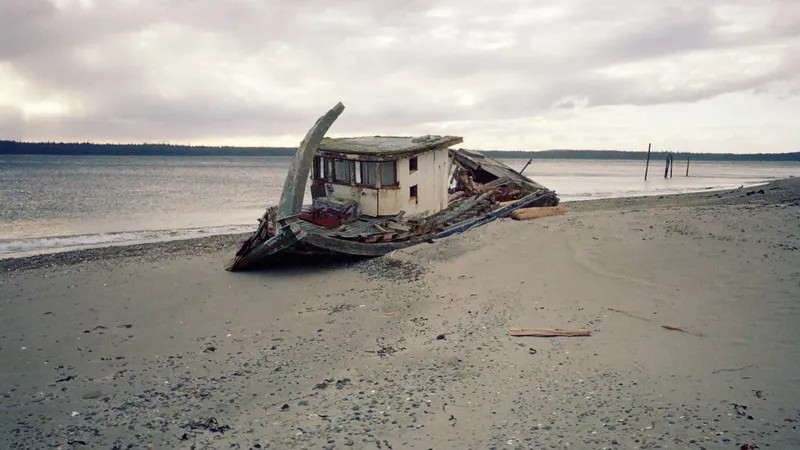
Near the war memorial with its grassy sward, a clutch of the city’s oldest structures are slowly crumbling toward the sea. The redbrick building where I began my career as a counselor is there, an edifice that was a shoe factory when my grandmother came to this city more than a hundred years ago. Farther up the hill, old hotels and industrial buildings and mansions are the concentrated relics of this neighborhood, built for citizens of a city that no longer exists in this place.
The momentum of gentrification, its eastward nudging of those inconsistent with urban efficiency, may be described by an imaginary line running parallel to the streets. West of the line lies industry, development, modernity; east of the line is poverty, destitution, addiction. The line is not a fixed border but rather a boundary of loose tendrils and eddies. At any given moment this zone is dominated by construction and renovation projects that crunch eastward a little more each year.
This line—invisible but palpable, economic but also psychological—is more than a feature of urban geography. It’s a metaphor for the fundamental dynamics of how we organize our cities, our consciousness, our capacity to hold or displace what troubles us. And it maps precisely onto an inner line that runs through the landscape of addiction itself.
The Inner Line: Where Recovery Begins
The line cannot be dissolved or extinguished. It is a manifest function of human nature and is matched by the line drawn upon the inner life of those struggling with addiction. On one side of the inner line is a legacy of wounds and neglect and a conviction of one’s own fundamental impoverishment. On the other side lies renewal, and clarity, and the transformation of those twisted wounds into wisdom.
Among substance users, the location of this inner line is defined by a specific moment: the day on which the decision is made to stop using. The line might move, of course, staggering back and forth in a series of relapses; or it might spread all the way across the inner landscape, remaking the ground in a new image of creation. However it travels, and is encountered, this line is the longitude of addiction.
This inner line represents a shift from one stable pattern to another. The addicted system has organized itself around keeping certain unbearable experiences at bay, using substances or behaviors as both protection and prison. The decision to stop using isn’t simply a cognitive choice or an act of willpower—it’s a reorganization of the entire system, a shifting of the boundary between what has been and what might become.
If you are reading this as a parent or loved one, you may be wondering: what makes the line move? What determines whether your loved one crosses from one territory to the other? The answer is more complicated than motivation or willpower—and understanding it may change how you think about recovery and your role in supporting it.
If you are reading this as someone whose own inner line has been stuck, or moving back and forth, or perhaps just becoming visible—then this chapter is about what lies on the other side, and what might help you cross.
The Frozen Landscape: Development Interrupted
Among the addicted, psychological growth is impaired during the entire period of use, from the outset of the habit until its discontinuation. Most substance users become addicted in early adolescence, somewhere between ages nine and fifteen. This span is intended to be one of psychological integration, of piecing together diverse aspects of the self to construct a unified identity.
Addiction introduces a caesura into the natural rhythm of development. Consequently, addicted adults are frozen at the emotional age at which they began using. This is also true of many survivors of childhood trauma. They become stuck, their inner life frozen at a certain age, the momentum of their development halted by the inertia of the wound.
This isn’t metaphor—it’s observable reality. In residential treatment programs, this dynamic has the peculiar effect of creating the precise emotional environment of early high school. Cliques, competition, posturing, insecurity, overwhelm. Men tend toward caricatures of machismo, as is common among fourteen-year-old boys. Women vary in their archetypes. The dynamics are recognizable to anyone who remembers being young.
For families, understanding this developmental freeze is an essential insight. You’re not dealing with an adult who has adult capacities temporarily impaired—you’re dealing with someone whose development was interrupted at a critical window and who must now complete that development while simultaneously managing the complexity of adult life. They’re navigating both territories at once: the delayed adolescent integration that should have happened fifteen years ago and the immediate demands of being thirty-five, forty, fifty years old.
The addiction stabilized the system in an immature configuration, preventing the natural reorganization that occurs through adolescence into young adulthood. Recovery requires not just stopping the substance use but facilitating the developmental transitions that were forestalled—allowing the system to complete its unfinished growth.
How long does this take? Adolescents develop toward integration and identity in about fifteen years. Adult users in recovery complete their delayed adolescent development in roughly three to five years. The first year is the hardest, requiring the most care and sensitivity. The temperament of the user in early recovery is fragile, and flurried, and mutinous.
The Question of Success: What Are We Measuring?
In the first years of my practice, a colleague and I would meet at a small diner that sat precisely on the city’s invisible line. One afternoon, we had a list: all the clients from the previous two years. We reviewed it to establish how well we were doing. How many clients were improving, recovering, healing?
We reviewed the list, name by name. Some clients had vanished, or died. Some had walked out. Others did everything we asked—showed up faithfully, spoke with increasing honesty, tried the approaches we offered—and nothing shifted. The addiction kept its grip. This was not about their failure or ours. It was about the complexity of what we were attempting.
The alchemy of transmutation is often what the addicted seek and what their families expect: a revolution in character and behavior, a charming and spiffy new self, shiny enough to banish the old shadows. And indeed we found two such examples on our list. One per year. People who seemed on the threshold when they came in, already undergoing a sea change.
I asked my colleague if he thought two successes in two years was enough. It seemed an awfully small number. And I, who was starting out in those days, wanted a tangible sense of progress, of efficacy.
He did not answer. Instead, he asked another question: is one success enough?
What about the client who spoke, finally, of his experiences in Vietnam? What of the woman who decided, after decades of denial, to face the fact of her husband’s violence? What of the dozens of clients, broken and discouraged, who found companions and discovered the shreds of their dignity?
This question—is one success enough?—fundamentally reoriented my understanding of the work. It shifted me from aggregate thinking to individual presence, from statistical outcomes to specific encounters, from measuring impact to simply showing up.
Prime Numbers on an Infinite Line
In my own work, I have come to perceive those who find their way home as the prime numbers. Their success cannot be predicted or derived from simple steps. No single path exists upon which they are found, no pattern of searching will find them. Yet their success is not random. Successfully recovered people demonstrate tendencies—openness, adaptability, clarity, personal warmth—that distinguish them to the practiced eye.
The numbers speak for themselves: upon an infinite line of potential suffering there reside an infinite number of places for healing. The statistics winnow down the aggregates to bare and shrinking numbers; whereas the individual primes grow upon that number line, they increase without end, and they cannot be reduced nor divided. They go on forever.
Prime can refer to a distinguishing mark. And typically, the mark of addiction is clear and unequivocal—not to the public, perhaps, but to those who share in the cultures of addiction. Sometimes the mark is perceived as a stain, or a badge, or a soft place of ramshackle wisdom. It remains, this calligraphy of scars, rendering the burned lines into relief. These scars travel across soft and fragile skin, tracing paths of distress, linking ridges and hollows of hard-won knowing. This scarification, which marks the sacred and the priestly in many cultures, is the stigmata of recovering addicts also. Few would wish away these primal scars.
What Draws Someone Across the Line
What makes the territory on the other side visible enough to move toward? Research on recovery consistently points to a few key factors: purpose, meaning, connection, contribution. People don’t recover from addiction so much as they recover to something—a reason to live differently, a role to play, relationships that matter, work that has meaning.
Research consistently reveals that the mechanism of change is not any particular program or technique. What heals is belonging. The actual predictive factors for sustained recovery are social support, recovery-oriented networks, and purposeful contribution to others. The person who finds community—who becomes essential to something, who is welcomed and valued, who can extend a hand to others still struggling—this person has something to return to that no program could provide.
Belonging comes not from following instructions but from contributing something only you can offer. A woman in a group I led found her place not by completing assignments but by noticing what others missed—she saw a solution that required her particular skills, her particular presence. She mattered because she contributed. She belonged because she was essential.
This is the paradox of belonging: it cannot be prescribed but must be provided for. You cannot program the moment of contribution into existence. But you can create conditions where such moments become possible—communities that welcome each person’s unique offering, spaces where presence and participation are valued, relationships where the person is needed, not just tolerated.
Why Programs Matter Less Than People
Since I began in this business, new models have followed a predictable trajectory. First there is revelatory enthusiasm fueled by fantastic anecdotes of client transformation. The new model will, it is claimed, fundamentally change the field. Then these assertions are bolstered by research results showing impressive numbers. Then come practitioner training, books, media reports.
By then, the limited usefulness of the model—it works only with certain clients, and in specific situations—is buried by the momentum of marketing. Eventually, the limitations become known and the model takes its place behind another new and emerging model.
The clients who do well speak not of models but of people: empathic, caring, compassionate. The counselors who demonstrate such qualities tend to have clients who report progress. This is, perhaps, the model of common sense, which does not try to establish a scientific determinism for which human nature is ill-suited.
Complex living systems don’t respond well to reductive interventions. They respond to conditions that allow new patterns to emerge, to environments that support reorganization, to relationships that provide both safety and challenge. The therapeutic relationship isn’t the delivery mechanism for a technique—it is the intervention.
The model that matters is the one we rarely name: presence, authenticity, sustained attention, genuine care. These aren’t techniques that can be manualized. They’re qualities of being that emerge from the helper’s own journey through darkness, their own commitment to remaining tender-hearted.
For Parents and Loved Ones: What This Means for You
If you’ve read this guide looking for programs, techniques, interventions—something you can do to help your loved one cross their inner line—I want to be honest with you.
You cannot make them cross. The inner line moves through forces largely beyond your control—meaning, purpose, connection, the accumulated experiences that teach the nervous system something new. You can create conditions that support crossing. You cannot force the crossing itself.
Belonging matters more than programs. The research is clear: what predicts recovery is social support and purposeful contribution, not any particular set of steps or techniques. If you want to help, look for ways your loved one might find belonging—community where they’re welcomed, contribution where they’re needed, connection where they matter to people who matter to them.
The developmental work takes years. Your loved one isn’t an adult who temporarily lost capacities. They’re someone whose development was interrupted, who must now complete adolescent integration while managing adult life. This takes three to five years at minimum. The first year is the hardest. Patience is not optional.
Resistance makes sense. When your loved one pulls back from recovery, returns to use, seems to sabotage their own progress—remember: they are protecting themselves from what was once unbearable. You cannot argue someone across their inner line. The nervous system doesn’t negotiate verbally.
Your presence matters more than your interventions. The quality that matters in helping relationships is not technique but tenderness—the capacity to remain open-hearted, to meet them where they are, to hold space for both their brokenness and their wholeness. This is harder than any program.
The line will move in its own time. You can be the shore that calls them home, the light that shows the territory on the other side is worth reaching. But you cannot drag them across. Recovery unfolds according to its own logic, responding to accumulated experience, to the gradual building of capacity, to the emergence of reasons to live differently.
If You Recognize Your Own Moving Line
If you’re reading this and recognizing your own inner line—stuck, moving back and forth, perhaps just becoming visible—I want to speak to you directly.
The territory on the other side is real. It’s not just absence of addiction—it’s presence of something worth living for. Purpose, meaning, connection, contribution. The question isn’t just how to stop using but what you’re crossing toward.
Find belonging, not just treatment. What heals is community where you’re welcomed, where you can contribute, where your presence matters. Look for places where you might belong—not programs to complete but communities to join.
The developmental work takes time. You’re not just quitting a substance—you’re completing development that was interrupted years ago. This takes three to five years. The first year is hardest. Be patient with yourself.
Resistance is protective. If you find yourself pulling back from recovery, returning to use, sabotaging your own progress—you’re protecting yourself from what feels unbearable. This isn’t weakness. But the protection that once saved you may now be imprisoning you. The question is whether you can build enough capacity, enough support, enough belonging that crossing becomes survivable.
Your scars become your marks. The calligraphy of scars—the hard-won knowing, the paths traced through distress—these don’t disappear in recovery. They become marks of wisdom, evidence of what you survived, credentials for helping others who are still struggling. Few would wish away these primal scars.
Infinite Places for Healing
The infinite line extends in both directions: backward into accumulated suffering, forward into ongoing creation of new possibilities. The line will keep moving through the city, pushing people eastward. The statistics will continue to be daunting.
And somewhere in that infinite sequence, a prime number emerges. Someone crosses their inner line. Someone decides they’re worth saving.
On an infinite line, every prime matters. Each individual transformation changes the mathematical landscape, creates new possibilities, maps new territory. The work is not about percentages and outcomes. It’s about showing up, bearing witness, remaining tender-hearted, seeking redemptive moments.
The line cannot be dissolved or extinguished. It is a manifest function of human nature. But it can move. It can spread all the way across the inner landscape, remaking the ground in a new image of creation. This is what we work toward: not the elimination of the line but its transformation from a boundary of exclusion into a threshold of possibility.
For Further Reflection
If You’re a Parent or Loved One
- What does “success” mean to you? Can you shift from aggregate thinking to individual presence, from measuring outcomes to simply showing up?
- How might your loved one find belonging—community where they’re welcomed, contribution where they’re needed?
- Can you be patient with a developmental process that takes years, not months?
- What would it mean to be the shore that calls them home, rather than trying to drag them across the line?
- How do you tend to yourself while holding space for their uncertain journey?
If You Recognize the Pattern in Yourself
- What lies on the other side of your inner line? Not just absence of addiction, but presence of what?
- Where might you find belonging—community where you can contribute, where your presence matters?
- Can you be patient with developmental work that takes years?
- What would it mean to see your scars not as stains but as marks of wisdom, credentials for the territory you’ve crossed?
- Is one success enough? Is your own crossing enough to change the mathematical landscape for those who come after?
This page is part of the Guide for Parents